Welcome to the Bridge to Freedom Foundation Blog
Thank you for visiting the Bridge to Freedom Foundation (BTFF) blog, where we look forward to bringing you inside information on the inner-workings of BTFF, inside information on our volunteer team and leadership, in-depth coverage of BTFF and partner events, news and happenings from across the globe and so much more.
Learn more about Bridge to Freedom Foundation and how you can help on the BTFF website. We do hope you will subscribe to and follow our blog and please e-mail us at blog@btff.org if you have any feedback, ideas or contributions.
Thank you for your support!
Cassandra Clifford
Executive Director and Founder of BTFF
Showing posts with label domestic sex trafficking. Show all posts
Friday, January 17, 2014
Fact: Human Trafficking is a $34 Billion Dollar a Year Business
According to ILO (International Labor Organization), the estimated total global profits from Human Trafficking are $34 billion a year 21 billion forced labor 13 billion for sex trafficking More males victims are now being recruited for the labor force.
Monday, December 16, 2013
Modern Slavery News Round-Up
U.N., U.S. Call for Investigations into Thai Trafficking of Rohingya
Following a Reuters report of Thai involvement in the transport of Myanmar refugees into human trafficking organizations, the United Nations and the United States demand investigations of the situation. The plight of the Rohingya, a Muslim people residing in Myanmar but not recognized as citizens, has remained largely unnoticed by the international community until recently. Clashes between the Rohingya and the ethnic Rakhine Buddhists have placed the former in an extremely vulnerable position and their attempts to flee to a safer location have made them the perfect target for established trafficking rings.
Russia Launches Criminal Inquiry into U.S. Child Exchanges
Russia’s Investigative Committee has indicated that it is looking into whether Russian children adopted by American families were illegally trafficked in the United States. The probe comes in response to a Reuters series that showed how U.S. parents have used Internet bulletin boards on Yahoo and Facebook to offload children they adopted but no longer want.
Human Trafficking Bill Aims to Save More Children
The Strengthening the Child Welfare Response to Human Trafficking Act, sponsored by Sen. Kay Hagan, D-N.C., and Marco Rubio, R-Fla., was introduced in the U.S. Senate this past Friday, December 13, and would help develop a uniform treatment toward minors who are victims of human trafficking or at-risk for being targeted by traffickers. The bill would also help officials understand the scope of the problem.
Following a Reuters report of Thai involvement in the transport of Myanmar refugees into human trafficking organizations, the United Nations and the United States demand investigations of the situation. The plight of the Rohingya, a Muslim people residing in Myanmar but not recognized as citizens, has remained largely unnoticed by the international community until recently. Clashes between the Rohingya and the ethnic Rakhine Buddhists have placed the former in an extremely vulnerable position and their attempts to flee to a safer location have made them the perfect target for established trafficking rings.
Russia Launches Criminal Inquiry into U.S. Child Exchanges
Russia’s Investigative Committee has indicated that it is looking into whether Russian children adopted by American families were illegally trafficked in the United States. The probe comes in response to a Reuters series that showed how U.S. parents have used Internet bulletin boards on Yahoo and Facebook to offload children they adopted but no longer want.
Human Trafficking Bill Aims to Save More Children
The Strengthening the Child Welfare Response to Human Trafficking Act, sponsored by Sen. Kay Hagan, D-N.C., and Marco Rubio, R-Fla., was introduced in the U.S. Senate this past Friday, December 13, and would help develop a uniform treatment toward minors who are victims of human trafficking or at-risk for being targeted by traffickers. The bill would also help officials understand the scope of the problem.
Wednesday, November 13, 2013
Tips for Law Enforcement to Efficiently Detect, Prevent, and Deter Human Trafficking
- Train personnel on the indicators of human trafficking and on effective interviewing of potential victims who, in most cases, do not self-identify.
- Educate the public about human trafficking and concentrate on the vulnerable populations of the community.
- Develop government and non-government partnerships to achieve a unified enforcement action against human trafficking while providing aftercare for the victims.
- Collect information and intelligence to identify the criminal networks, traffickers, persons of interest, locations, and financial aspects involved in the illegal trafficking operations. Investigate those people and locations linked to human trafficking and explore prosecution for any subsequent crime.
- Target high risk areas for human trafficking to better utilize limited resources while tracking and assessing activity and enforcing laws.
- High risk areas include brothels, strip clubs, escort services, and massage parlors.
- Use proactive enforcement during the peak hours in and around locations linked to human trafficking.
- Develop informants from individuals who are arrested and use the information to further the investigation into trafficking networks.
- Explore the use of modern technology and science to aid in the investigation, evidence collection, and prosecution efforts.
- Seize assets to hinder and disrupt individuals and organizations involved in human trafficking. Prosecute the defendants and publicize success stories.
Read more: http://communities.washingtontimes.com/neighborhood/speaking-out/2013/oct/30/ten-tips-law-enforcement-decrease-human-traffickin/#ixzz2kYi7fuev
Friday, November 8, 2013
Fact: 15 & 76% of women are targeted for physical and/or sexual violence in their lifetime
Between 15 and 76 percent of women are targeted for physical and/or sexual violence in their lifetime, according to the available country data. Most of this violence takes place within intimate relationships -this can include relationships with traffickers or pimps-, with many women (ranging from 9 to 70 percent) reporting their husbands or partners as the perpetrator (UNWomen).
Awareness and Prevention -as well as ending the demand for sex and gender discrimination are all keys to ending all forms of gender-based violence. However as the statistics show women must seek to take back their control and never be surprised for surprises -it can happen to anyone and anywhere. Therefore Bridge to Freedom's Violence Prevention Program not only seeks to empower survivors of modern slavery, but equip all women and girls to avoid, prevent, deescalate and/or counter such threats or attacks. Help us change these statistics today by participating in and supporting our Violence Prevention Program here!
Thursday, November 7, 2013
Violence Prevention Workshops A Fighting Success
As you may have recently read on our blog, website and other social media outlets Bridge to Freedom Foundation recently launched a new Violence Prevention Program. We have been excited to be able to bring the life saving techniques of Krav Maga -a real life self-defense system- to survivors of human trafficking.
Our first survivor workshop was held just last month in Kansas City, Missouri, and we are excited to announce that they were a fighting success! On October 24rd, I traveled to Kansas City to run our first official Violence Prevention Workshop Fundraiser for the community. Which I am very excited to report back to you that it was a great successes and funded the next phase of my journey to train local survivors of sex trafficking. This trip was important in so many ways, one I was getting to return back to my hometown and begin to see my dream and life's work go full circle. It was also exciting -and a bit nerve racking- to finally be able to share my love of Krav Maga with many of my family and friends. It was defiantly an interesting experience teaching a class with siblings, parents, childhood friends and all their friends, but so great to let them see first hand what I have been talking about and training so hard on. Not to mention I want to ensure that everyone has access to true and easy to implement self-defense training, as my motto for self-defense -and much of life- is "Don't be Surprised for Surprises"!
On that note I am without words to really tell you how excited I am to report back that our first workshop(s) with the amazing survivor lead organization in Kansas City, MO, Veronica's Voice on the 24th of October, was an amazing success. First of all I have to thank everyone at Veronica's voice for all the hard work you do everyday and allowing us to be part of your family and for seeing the value in every aspect of survivors lives -including their personal safety. Most of all I have to thank the amazing women who spent the day learning, laughing, sharing, bonding and most of all learning some...well shall we say it....Kick Ass Self-Defense techniques! These life saving skills we hope will keep all of these women out of harms way and empowered to fight should they have to!
Our mission at BTFF is to see that all survivors of modern slavery have the tools and resources to lead thriving lives and we know that this includes developing the mental mindset of a fighter. Our Violence Prevention Program, does just that and we hope you will help support us on this journey and consider sponsoring a survivor or workshop here: http://www.razoo.com/story/Violence-Prevention-Self-Defense-Workshops.
If you are a survivor and would like to inquire about free training or would like to book a self-defense workshop for your clients or outreach team, please contact us at info@btff.org and we will contact you with more information and to schedule your training. Additionally if you would like to host a community self-defense workshop and not only ensure your community is equipped for any situation, but also raise funds for free survivor training please contact us to book a workshop.
Wednesday, November 6, 2013
Demand Change in the Heartland
It is with great pleasure that I was able to travel to Kansas City, Missouri in October to not only conduct Violence Prevention Workshops, but to attend the Demand Change in the Heartland Conference. The conference was hosted by Veronica's Voice and featured a survivor only led panel. This amazing panel of determined, courageous, inspiring and spirited group of fighters not only shared their stories, but more importantly focused on the hurdles that victims and survivors face on the road to recovery and to lead thriving lives.
Veronica's Voice's, Demand Change Conference truly amazed me in so many ways that I don't think I can even share enough with you. I was immediately awoken from my early morning daze and incredibly proud of the power of change that begun to kick off in the early morning on a a Saturday in America's Heartland -and my hometown. Hometown pride has a whole new meaning now...as does the true unbreakable spirit of a Midwestern girl -no one can hold a flame to the ladies that sought to bring this house down!
As an organization that is newer and who's mission is to bring those victimized by modern slaver from a point of surviving to thriving, I personally and professionally see survivor informed services as the only way forward. Bridge to Freedom Foundation is about the future not the past, and while we may hear many survivor stories along the way we let the survivor lead and never ask, "what happened", therefore this conference held a great deal of meaning for us and sought to ensure we continue to learn and grow from the survivor community. BTFF strives to ensure we never forget who it is we work for and why. Kristy Childs Founder and Director of Veronica's Voice, ut it best; "Let survivors share their story and what they want to share. Be mindful, have compassion without the details. That is dignity!. Childs also added, "...when we see some as worthy victims an others as unworthy, we are causing great harm."
One of the day's key topics was the re-victimization of victims and the labeling placed on them, including that treating and arresting as criminals and using victimizing words such as "prostitute". "Prostitution is an extension of slavery" added Vednita Carter of Breaking Free. Many survivors have criminal records, including felonies following arrests for prostitution charges and vacating such crimes is not easy nor possible in call states. Tina Frundt, Founder and Executive Director of Courtney's House broke down the harsh realities of labeling and the continual harm it causes as she spoke with unfiltered dynamism; "...what now at 20...22...I'm worth nothing because you didn't help me at 9?"
The harsh reality so many do not want to face or turn a blind eye to was not swept under the rug and even if you wanted to turn a blind eye you were too paralyzed to do so as the rooms power, inspiration, passion and leadership took you in and the heartfelt and intimate stories of the survivors took hold of you.
Brenda Myers-Powell , Founder of the Dream Catcher Foundation, spoke about her journey with a vibrancy and yet painstakingly sharp honesty that one so rarely hears on any stage; This was "...not something I got into it was something I was almost born into... All I waned to do was be shinny, but the shine kept getting taken away from me teach time I was molested." Myers-Powell was not alone on this stage sharing often painful intimate details of their path from victim, survivor to a empowered thriving woman, and all of these remarkable leaders filled the room with the loudest voices of truth one can find. Christine McDonald, who's book "Cry Purple", is one of the most heartwarming stories of courage, survival and triumph; showed that innocence does not have to be lost as she infected the room with her contagiously sweet laugh in the midst of telling stories that would have broke so many before they began.
The event put forward so many valuable lessons in a frank and feasible manner, that makes one question why we have not been talking like this (or listening) and resolving these issues all along. Survivor informed and led services are key to breaking the cycle and ensuring that those abused by the chains of human trafficking are enabled to lead thriving lives with dignity. "We need to be more than well- intended, we must be intentional!" stated, Dr. Karen Countryman-Roswurm. Intention to see one thrive and lead their own journey requires many steps and all must be informed, as Rowena Mathews, Alumni Member of Breaking Free stated; "We need a lot of little things before we are able to walk on our own."
The event even hosted a powerful dance performance; "The Game" by Erin Murphy, featuring the words and stories of survivors from Veronica's Voice. Like the performance this conference was truly a one of a kind inspirational event that drives you to act in an intentional and sustainable manner with the survivors needs at the center of it all.
Monday, August 19, 2013
Modern Slavery News Round-Up
Human Trafficking Fighters Improve Rating for WyomingThe leading organization in the global fight against human trafficking and modern-day slavery lauded the state of Wyoming on Wednesday for finally adopting a law to combat the practices. The Polaris Project lifted its Wyoming rating from zero to tier two, with four being the highest, as a result of the legislation signed into law by Gov. Matt Mead last winter. Wyoming became the final state to adopt a statute outlawing human trafficking. Federal authorities previously had prosecuted such cases in Wyoming.
Trial Date Set in Sex Trafficking Case.
A federal judge in Wichita has scheduled an October trial for three people charged in a sex trafficking scheme linked to Asian massage parlors. U.S. District Judge Eric Melgren on Wednesday issued an order scheduling an Oct. 15 trial for Gary H. Kidgell; his wife, Yan Zhang; and employee Xiuqing Tian. They are accused of conspiring to recruit women from around the country to come to Wichita to work at massage parlor, then coercing them into prostitution.
From Foster Care into Sex Trade.
Every year, federal and state governments pour millions of dollars into combating sex trafficking through local and federal law enforcement agencies. But the emerging link between the child welfare system and child sex trafficking in the United States underscores the need for a new tactic, one that addresses the social origins of child sex trafficking.At the end of July, the FBI’s Innocence Lost initiative, the wing of the agency tasked with addressing domestic child sex trafficking, conducted its annual three-day Operation Cross Country. During these 72 hours, federal agents across the country “recover” juvenile victims from sexual exploitation and arrest their exploiters. This year, the agency boasts that it saved 105 children and arrested 152 pimps. According to U.S. law, anyone under 18 and involved in the sex trade is considered sexually trafficked.
Kansas Anti- Human Trafficking Efforts Gain Attention.
Kansas is earning national recognition for its efforts to combat human trafficking. An annual report from the "Polaris Project" puts Kansas in the top group of states in fighting human trafficking crimes. The report ranks Kansas in a tie for 11th-best overall. Last year, the state ranked in the bottom third. Kansas Attorney General Derek Schmidt credits a new state law for the jump. Enacted earlier this year, it increases services for human trafficking victims and strengthens support for enforcement of anti-human trafficking laws.
Thursday, July 25, 2013
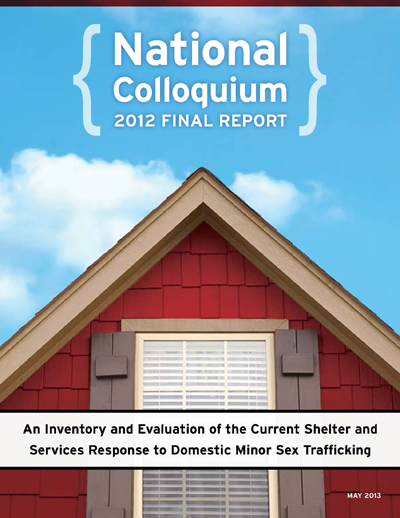
Report Highlights the Lack of Beds for Domestic Minor Victims of Sex Trafficking
On July 8, a briefing was held in Washington DC, to discuss the results of the National Colloquium on Shelter and Services for Domestic Minor Sex Trafficking Victims. The event was organized by Shared Hope International, and presented by Congresswoman Linda Smith, President and Founder. The live streamed event was held in coordination with Senators Portman and Blumenthal, Co-Chairs of the Senate Caucus to End Human Trafficking; Reps. Ted Poe and Jim Costa, Co-Chairs of the Congressional Caucus for Victims' Rights and Represenitives Jaime Herrera Beutler and Donna F. Edwards, Co-Chairs, and Reps. Kristi Noem and Doris O. Matsui, Vice-Chairs of the Congressional Caucus for Women's Issues. Participants discussed trends and obstacles in establishing treatment facilities for underage victims of sexual exploitation and trafficking.
The National Colloquium Report provides policy makers, government agencies, service providers, and law enforcement with an overview of current services and shelter delivery models. Due to the nature of the crime of commercial sexual exploitation of children, we all know that multiple systems interact with child victims and collaboration is critical among law enforcement, child welfare agencies, and other first responders.
Among the issues discussed was the current status of providers of shelter and victim services for youth victims of domestic minor sex trafficking within the United States, and the glaring lack of beds -there are currently only 226 beds available to youth victims of sex trafficking in the U.S. Also acknowledged were the community-based service providers, which, according to the report, can offer space for up to 1,684 minor victims of sexual exploitation. These numbers are an important indicator that the US has grown in the capacity to provide service to victims, but also have improvements to make. The Executive Director went on the address issues with services and shelters that were identified in the report, one being the geographical disparity between high-traffic areas and the locations of service providers.
The report shows that of practitioners providing direct services reported they receive referrals from juvenile probation from child protective services, and law enforcement. In addition, three national surveys for providers, survivors, and advocates and funders were developed and distributed and over 100 expert individuals and organizations completed the surveys. Responses were collected from 51 organizations, 33 survivors and 18 national advocacy and funding experts. The report includes 26 specific recommendations in 5 categories: Placement and services for identified youth, Licensing and maintaining shelter and programs, Identifying sustainable resources, Programmatic/therapeutic responses, and Safety and security recommendations
Click here to read the full report!
The National Colloquium Report provides policy makers, government agencies, service providers, and law enforcement with an overview of current services and shelter delivery models. Due to the nature of the crime of commercial sexual exploitation of children, we all know that multiple systems interact with child victims and collaboration is critical among law enforcement, child welfare agencies, and other first responders.
Among the issues discussed was the current status of providers of shelter and victim services for youth victims of domestic minor sex trafficking within the United States, and the glaring lack of beds -there are currently only 226 beds available to youth victims of sex trafficking in the U.S. Also acknowledged were the community-based service providers, which, according to the report, can offer space for up to 1,684 minor victims of sexual exploitation. These numbers are an important indicator that the US has grown in the capacity to provide service to victims, but also have improvements to make. The Executive Director went on the address issues with services and shelters that were identified in the report, one being the geographical disparity between high-traffic areas and the locations of service providers.
The report shows that of practitioners providing direct services reported they receive referrals from juvenile probation from child protective services, and law enforcement. In addition, three national surveys for providers, survivors, and advocates and funders were developed and distributed and over 100 expert individuals and organizations completed the surveys. Responses were collected from 51 organizations, 33 survivors and 18 national advocacy and funding experts. The report includes 26 specific recommendations in 5 categories: Placement and services for identified youth, Licensing and maintaining shelter and programs, Identifying sustainable resources, Programmatic/therapeutic responses, and Safety and security recommendations
Click here to read the full report!
Monday, July 15, 2013
Modern Slavery News Round-Up
Feds Arrest 255 in Massive Global Child Porn Sting
As part of its attempt to combat a growing trend of online sexual exploitation, the U.S. Immigration and Customs Enforcement agency announced on Monday that 255 suspected child predators had been arrested during a nearly five-week sting operation. Operation iGuardian sought to identify and arrest those who allegedly "own, trade and produce" child pornography in the United States and its territories. Authorities also identified and rescued 61 alleged victims in the United States, Canada, Indonesia and the Netherlands, according to a statement from ICE. The suspects, 251 of whom were men and four were women, face charges ranging from online sexual enticement of a minor to child pornography production and traveling with the intent to have sex with a minor. Some were also charged with rape and molestation and distribution of child pornography. Read more here.
Saudi Princess Charged With U.S. Human Trafficking
Suitcase in hand, the 30-year-old domestic worker from Kenya managed to flag down a Southern California bus and tell a passenger she had been held against her will and believed she was a victim of human trafficking. It wasn't long before a Saudi princess was under arrest. Meshael Alayban, who prosecutors said is one of the wives of Saudi Prince Abdulrahman bin Nasser bin Abdulaziz al Saud, was charged Wednesday with human trafficking. She was arrested at an Irvine condominium that policed searched after talking to the Kenyan woman. The woman told authorities she had been hired in Kenya in 2012 and taken to Saudi Arabia, where her passport was immediately taken. She said she was forced to work excessive hours, was paid less than promised and was not allowed to leave. Read more here.
Utah Massage Parlor Owner Sent to Prison for Human Trafficking
A Salt Lake City massage parlor owner has been sentenced to prison for coercing a 17-year-old girl into being a prostitute. Luis Daniel Arano-Hernandez, 30, in May accepted a plea deal and pleaded guilty to one charge of human trafficking, a first-degree felony. Third District Judge Judith Atherton sentenced Arano-Hernandez to five years to life in prison on Friday. Arano-Hernandez, along with three other men and one women, were arrested and charged last November by the SECURE Strike Force after an eight-month investigation into sex trafficking. The women engaged in providing prostitution services are believed to have been undocumented immigrants and/or under the age of 18. In a probable cause statement filed with the court, a female identified as "M.R." said she was forced to sign a contract and that Arano-Hernandez threatened to harm the teen’s family and have her deported if she failed to participate in prostitution. Read more here.
Federal Judge Blocks N.J. Human Trafficking Law Targeting Underage Sex Ads
A new state law intended to root out online advertisements for underage sex has been blocked by a federal judge. The law -- signed by Gov. Chris Christie in May and slated to go into effect at the beginning of this month -- makes it a first-degree crime to knowingly publish, disseminate or display an advertisement and any photographs promoting sex with a minor. Backers of the measure said it was needed to hold websites responsible for perpetuating child sex abuse and underage prostitution. Two web companies sued last month claiming the state law, while well-intentioned, violates a long-standing federal law that grants websites sweeping immunity from being held liable for the material people post online. U.S. District Judge Dennis Cavanaugh temporarily blocked New Jersey’s law June 28, and the state faces a steep legal climb when oral arguments begin in Newark on Aug. 9. Read more here.
S. Korean Court Orders Nippon Steel to Pay for Forced Labor
A South Korean court, in an unprecedented ruling, ordered Japan's Nippon Steel & Sumitomo Metal Corp. on July 10 to compensate four South Koreans for forced labor during Japan's 35-year colonial rule of Korea. The Seoul High Court ordered the company to pay 100 million Korean won ($88,000) to each of the four plaintiffs. It rejected Nippon Steel's argument that it was a different entity from the steelmaker that employed the South Koreans. Japanese courts have thrown out claims by South Korean who suffered at Japanese hands during World War II, arguing the matter of compensation was closed under the 1965 treaty between the two countries normalizing diplomatic ties. Nippon Steel, which merged with Sumitomo Metal Industries last year, has argued in previous court cases that it was not responsible for the actions of the wartime steelmaker. The attorney for the plaintiffs, Kim Mi-kyung, said they had no immediate plans to take action to seize company assets in South Korea, but wanted to discuss compensation with the company. Nippon Steel said it would appeal the decision. Read more here.
As part of its attempt to combat a growing trend of online sexual exploitation, the U.S. Immigration and Customs Enforcement agency announced on Monday that 255 suspected child predators had been arrested during a nearly five-week sting operation. Operation iGuardian sought to identify and arrest those who allegedly "own, trade and produce" child pornography in the United States and its territories. Authorities also identified and rescued 61 alleged victims in the United States, Canada, Indonesia and the Netherlands, according to a statement from ICE. The suspects, 251 of whom were men and four were women, face charges ranging from online sexual enticement of a minor to child pornography production and traveling with the intent to have sex with a minor. Some were also charged with rape and molestation and distribution of child pornography. Read more here.
Saudi Princess Charged With U.S. Human Trafficking
Suitcase in hand, the 30-year-old domestic worker from Kenya managed to flag down a Southern California bus and tell a passenger she had been held against her will and believed she was a victim of human trafficking. It wasn't long before a Saudi princess was under arrest. Meshael Alayban, who prosecutors said is one of the wives of Saudi Prince Abdulrahman bin Nasser bin Abdulaziz al Saud, was charged Wednesday with human trafficking. She was arrested at an Irvine condominium that policed searched after talking to the Kenyan woman. The woman told authorities she had been hired in Kenya in 2012 and taken to Saudi Arabia, where her passport was immediately taken. She said she was forced to work excessive hours, was paid less than promised and was not allowed to leave. Read more here.
Utah Massage Parlor Owner Sent to Prison for Human Trafficking
A Salt Lake City massage parlor owner has been sentenced to prison for coercing a 17-year-old girl into being a prostitute. Luis Daniel Arano-Hernandez, 30, in May accepted a plea deal and pleaded guilty to one charge of human trafficking, a first-degree felony. Third District Judge Judith Atherton sentenced Arano-Hernandez to five years to life in prison on Friday. Arano-Hernandez, along with three other men and one women, were arrested and charged last November by the SECURE Strike Force after an eight-month investigation into sex trafficking. The women engaged in providing prostitution services are believed to have been undocumented immigrants and/or under the age of 18. In a probable cause statement filed with the court, a female identified as "M.R." said she was forced to sign a contract and that Arano-Hernandez threatened to harm the teen’s family and have her deported if she failed to participate in prostitution. Read more here.
Federal Judge Blocks N.J. Human Trafficking Law Targeting Underage Sex Ads
A new state law intended to root out online advertisements for underage sex has been blocked by a federal judge. The law -- signed by Gov. Chris Christie in May and slated to go into effect at the beginning of this month -- makes it a first-degree crime to knowingly publish, disseminate or display an advertisement and any photographs promoting sex with a minor. Backers of the measure said it was needed to hold websites responsible for perpetuating child sex abuse and underage prostitution. Two web companies sued last month claiming the state law, while well-intentioned, violates a long-standing federal law that grants websites sweeping immunity from being held liable for the material people post online. U.S. District Judge Dennis Cavanaugh temporarily blocked New Jersey’s law June 28, and the state faces a steep legal climb when oral arguments begin in Newark on Aug. 9. Read more here.
S. Korean Court Orders Nippon Steel to Pay for Forced Labor
A South Korean court, in an unprecedented ruling, ordered Japan's Nippon Steel & Sumitomo Metal Corp. on July 10 to compensate four South Koreans for forced labor during Japan's 35-year colonial rule of Korea. The Seoul High Court ordered the company to pay 100 million Korean won ($88,000) to each of the four plaintiffs. It rejected Nippon Steel's argument that it was a different entity from the steelmaker that employed the South Koreans. Japanese courts have thrown out claims by South Korean who suffered at Japanese hands during World War II, arguing the matter of compensation was closed under the 1965 treaty between the two countries normalizing diplomatic ties. Nippon Steel, which merged with Sumitomo Metal Industries last year, has argued in previous court cases that it was not responsible for the actions of the wartime steelmaker. The attorney for the plaintiffs, Kim Mi-kyung, said they had no immediate plans to take action to seize company assets in South Korea, but wanted to discuss compensation with the company. Nippon Steel said it would appeal the decision. Read more here.
Monday, July 1, 2013
Modern Slavery News Round-Up
20 Million People Are Trafficked in Modern Day Slavery – America is Leading the Fight to Stop It
One in three. That’s the number of women who will be sexually assaulted in their lifetimes, according to the United Nations. Depending on where they live, nearly three in five women will at some point endure physical violence. Of course, statistics don’t do justice to how brutally commonplace the occurrence of violence against women and girls is, whether in public or private spaces. The sad reality is these stories are reported in the news every day, all over the world in great detail from horrors in Delhi, India to Steubenville, Ohio. Unfortunately, these same news stories include messages of victim blaming, arguments of consent, and junk science meant to invalidate the seriousness of these crimes.
Arrest Made in Modern Slavery Case Involving a Mentally Disabled Women.
A mentally disabled woman and her daughter were held in an Ohio apartment crowded with people and animals for more than a year, forced to perform manual labor and threatened with dogs and snakes to keep them compliant, authorities said Tuesday.Federal prosecutors said the people accused of holding the pair in Ashland, about 60 miles south of Cleveland, collected the woman's government benefits and beat her in order to get painkillers for themselves. They kept her in a room with a free-ranging iguana and ordered her to feed the reptile fruits and vegetables her daughter was denied, according to court papers. Sometimes their captors' pit bulls got table food while they had to eat from cans, according to an arrest affidavit quoting witnesses. Local news shows captivating images of the traffickers, To view Click Here
Child Minors Face Death for Tech
Roger-Claude Liwanga is a human rights lawyer from the Congo and visiting scholar at Boston University. He worked for The Carter Center as a legal consultant, where he developed a training module to train Congolese judges and prosecutors on the protection of children against trafficking for economic exploitation in the mines. He is also the co-founder and executive director of Promote Congo, and is currently directing and producing a short documentary, “Children of the Mines,” which will be launched shortly in Boston. He writes in his personal capacity.
Compiled By: Markesha Fantroy
One in three. That’s the number of women who will be sexually assaulted in their lifetimes, according to the United Nations. Depending on where they live, nearly three in five women will at some point endure physical violence. Of course, statistics don’t do justice to how brutally commonplace the occurrence of violence against women and girls is, whether in public or private spaces. The sad reality is these stories are reported in the news every day, all over the world in great detail from horrors in Delhi, India to Steubenville, Ohio. Unfortunately, these same news stories include messages of victim blaming, arguments of consent, and junk science meant to invalidate the seriousness of these crimes.
Arrest Made in Modern Slavery Case Involving a Mentally Disabled Women.
A mentally disabled woman and her daughter were held in an Ohio apartment crowded with people and animals for more than a year, forced to perform manual labor and threatened with dogs and snakes to keep them compliant, authorities said Tuesday.Federal prosecutors said the people accused of holding the pair in Ashland, about 60 miles south of Cleveland, collected the woman's government benefits and beat her in order to get painkillers for themselves. They kept her in a room with a free-ranging iguana and ordered her to feed the reptile fruits and vegetables her daughter was denied, according to court papers. Sometimes their captors' pit bulls got table food while they had to eat from cans, according to an arrest affidavit quoting witnesses. Local news shows captivating images of the traffickers, To view Click Here
Child Minors Face Death for Tech
Roger-Claude Liwanga is a human rights lawyer from the Congo and visiting scholar at Boston University. He worked for The Carter Center as a legal consultant, where he developed a training module to train Congolese judges and prosecutors on the protection of children against trafficking for economic exploitation in the mines. He is also the co-founder and executive director of Promote Congo, and is currently directing and producing a short documentary, “Children of the Mines,” which will be launched shortly in Boston. He writes in his personal capacity.
Compiled By: Markesha Fantroy
Sunday, August 19, 2012
Another Victory: New State Joins in Vacating Convictions for Victims
Prostitution convictions for victims of forced prostitution and sexual exploitation are sadly all too often common aspects of human trafficking -modern slavery. Recently, Hawaii joined a small group of states who have passed legislation which will vacate prostitution convictions for victims of human trafficking. Hawaii's new law -SB 2576- “allows sex trafficking victims to vacate prostitution convictions from their criminal records by proving they were sexually enslaved”. Additional states with similar legislation include New York, Illinois, and Nevada; New York was the first state to enact such a law. While this is good news for many survivors -who find it increasingly difficult to attain or retain employment due to this such unjust and misunderstood convictions- there are a few criticisms. One argument questions “how useful a bill like SB2576 would be to many victims on a practical level […saying] that many victims are too afraid of their traffickers to testify against them to prove their victim status. Therefore, a vacating conviction law has no value to victims if it requires them to prove their sex trafficking history by testifying against traffickers” (Dale). Unfortunately, it seems that similar issues will arise in many cases of “vacating convictions” laws, as they do with cases of sexual assault and rape. In rape cases, it can be very difficult to prove that the incident occurred, in addition to the psychological turmoil of reliving such a traumatic event. Victims are often accused of provoking their attackers or of lying. The few cases in which it is later revealed that the victim was not actually a victim certainly does not help. In the same instance, victims of human trafficking/modern slavery endure the same fate as victims of rape. Their lawyers must prove, beyond a reasonable doubt, that they were trafficked and the victim has to relive that time in their life. In addition, there is the possible accusation that they are lying or that they were voluntary participants. Regardless of criticisms, many individuals and organizations view SB2576 and similar legislation, as a victory for victims. It is a new change and another chance for them to reintegrate into society with a clean slate. Dale, Youngbee. "Hawaii: New Law Allows Trafficking Victims to Vacate Prostitution Convictions." Washington Times Communities. N.p., 11 July 2012. Web. 27 July 2012.
Friday, August 17, 2012
FACT: the average age of entry into prostitution is 12-14 years old.
Did you know that the average age of entry into prostitution is only a mere 12-14 years old?
Child prostitution is the commercial sexual exploitation of children, for which a child is held under force, fraud or corrosion to perform sexual services, for financial gain. Pimps/traffickers target girls -or women- who are homeless, appear naive, lonely or rebellious. The victim first finds themselves in the spotlight of the attention and affection of the pimp -who then convinces her to “be his woman.” Pimps/traffickers then keep these innocent girls -or women- in virtual captivity through verbal and physical abuse. Many sexually exploited youth have been so psychologically manipulated by their pimps/traffickers that they are often compelled to return to them -thus why the investment into the self-worth and long-term development of survivors is key to the work of Bridge to Freedom Foundation. It is estimated that some 80% to 95% of all prostitution is pimp-controlled.
Tuesday, July 24, 2012
Modern Slavery News Round-Up
Feds dismiss largest US human trafficking case
Last Friday a federal judge dismissed human trafficking charges against executives and associates of Global Horizons Manpower Inc., a labor recruiting company. The firm was accused of exploiting 600 of workers from Thailand through debt, confiscating passports and threats of deportation. The case was dropped after it was made clear to prosecutors that they could not prove the charges "beyond a reasonable doubt." Even Global Horizons attorney, Michael Green, stated that it was "very unusual" to dismiss a case with no intention of bringing it back.
Spotlight on human trafficking in Pennsylvania
A recent study released last month by a research agency has prompted an effort to legally define human trafficking in a broader sense in Pennsylvania. The state has been known as a "transportation hub", but the study shows that it is also a source and destination for victims of trafficking. Human trafficking was made a felony in 2006, but there is no clear distinction between labor and sex trafficking and victims are still treated as criminals. The study confess that "while the crime...is not in its infancy, combating [it] at the state level is new."
Teen's brothel escape triggers Mexico clampdown
Only 14 years old, two cousins were abducted while waiting for their evening bus home and then sold to a pimp who forced them into prostitution. These girls were beaten, raped, forced alcohol and drugs. They were witness to terrible crimes, including the induction of an eight year old into their world. After finally escaping, these girls' stories have resulted in the State's Attorney Office closing down 600 establishments and making human trafficking a federal crime, punishable up to 40 years in prison.
Last Friday a federal judge dismissed human trafficking charges against executives and associates of Global Horizons Manpower Inc., a labor recruiting company. The firm was accused of exploiting 600 of workers from Thailand through debt, confiscating passports and threats of deportation. The case was dropped after it was made clear to prosecutors that they could not prove the charges "beyond a reasonable doubt." Even Global Horizons attorney, Michael Green, stated that it was "very unusual" to dismiss a case with no intention of bringing it back.
Spotlight on human trafficking in Pennsylvania
A recent study released last month by a research agency has prompted an effort to legally define human trafficking in a broader sense in Pennsylvania. The state has been known as a "transportation hub", but the study shows that it is also a source and destination for victims of trafficking. Human trafficking was made a felony in 2006, but there is no clear distinction between labor and sex trafficking and victims are still treated as criminals. The study confess that "while the crime...is not in its infancy, combating [it] at the state level is new."
Teen's brothel escape triggers Mexico clampdown
Only 14 years old, two cousins were abducted while waiting for their evening bus home and then sold to a pimp who forced them into prostitution. These girls were beaten, raped, forced alcohol and drugs. They were witness to terrible crimes, including the induction of an eight year old into their world. After finally escaping, these girls' stories have resulted in the State's Attorney Office closing down 600 establishments and making human trafficking a federal crime, punishable up to 40 years in prison.
Thursday, July 5, 2012
"Stolen" Sneak Peak at DC SMS Meeting

Soon after McKenzie stepped down, Stacy Jewell Lewis stepped up to share with the audience a preview of the fear she felt as a victim from her upcoming play, Stolen: From Playgrounds to Streetlights, which will be premiering at the Atlas Theater in early August. A stirring and dramatic monologue, Lewis let her words create a scene of desperation and terror, but also one of hope- hope for survivors and also hope for the volunteers and activists dedicated to eradicating this epidemic. Her story will be one of many, including McKenzie's, that will be featured in her play as a call to action and a catalyst to ignite indignation and passion.This year DC Stop Modern Slavery and BTFF are partnering, along with another 13 organizations, for the Stop Modern Slavery Walk on September 29th at the Washington Monument. To register to be part of our team or to donate please click here. Not only will there be a walk, but survivors like McKenzie and Lewis will be present to speak, as well as musical performances.
In a week when we are hard pressed to reflect on our liberty in this country, we must also take the time to remember those whose freedoms have been abused. If you have come across ANYTHING that resembles human trafficking please call the hotline at 1-888-3737-888.
Tuesday, July 3, 2012
Modern Slavery News Round-Up
Nestlé advances child labor battle planAfter the chocolate producer's cocao supply chain was found with numerous child labor violations, Nestlé has allowed the Fair Labor Association to perform a study in order to start eradicating child labor within its production cycle. The investigation has uncovered numerous grievances including 72 injuries due to machetes and unpaid workers. Jose Lopez, the vice-president of operations, has promised that they desire to make an impact. "We will work with the World Cocoa Foundation and be in schools, we will work with International Cocoa Initiative and gather the cooperatives and put people there ... to give training on the farmers." Nestlé can now be held accountable for sustainable changes that can help bring about code-compliant cocoa.
Thailand remains major center for trafficking
According to their ministry of Social Development and Human Security, Thailand is still a soucre, transit and destination of modern slavery. Provinces in the north are starting points for domestic trades, but victims also arrive from Laos, Myanmar and China. One district, Songkhla Sadao, hosts 120 sex-offering establishments alone. According to many sources, the victims are entered into the trade at the age of 11 to 15. The anti-human trafficking unit rescued 36 underage girls from Myanmar last year alone. Human trafficking has also come to include boys and men who are forced to work on fishing trawlers.
Gov't drive against trafficking obtains budgetary support
The Inter-Agency Council Against Trafficking (IACAT)announced on the first that its proposed $100 million for 2013, which is double the current budget. IACAT head and Justice Undersecretary Jose Vicente B. Salazar says the budget is consistent with the recommendations made by the newly released Global Annual Trafficking in Persons Report. The funding will mainly go to address key issues such as advocacy, rehabilitation, prosecution and partnership. Although the plan has yet to be finalized, the next step is to send the proposal through to Congress after is resumes on July 23rd.
Monday, May 21, 2012
Modern Slavery News Round-Up
As a transportation hub with close proximity to major highways, human trafficking has come to Charlotte, North Carolina. Traffickers can pick up their victims and then easily leave, making it hard to find and prosecute them. State Attorney General Roy Cooper wants more public awareness and with the Democratic National Convention approaching, there's a growing concern of increased trafficking. "When there's more money to be made, people are going to take advantage of it...this is a $32 billion industry," says Charity Magnuson, leader of the NC Stop chapter. A this moment, there are 7 to 10 open human trafficking cases in the city.
Human Trafficking Crackdown in Northern Ireland
Since 2009, more than 70 women from a variety of countries such as Ghana, China, Slovakia and Zimbabwe have been rescued from human traffickers in Northern Ireland. Police believe that there are about 90 brothels that have tricked these women into coming to the country and then forced into sexual slavery by crime gangs. The increase in awareness can be partly attributed to a new working group, the All Party Group on Human Trafficking, that is lobbying for stronger legislation to make it more difficult for these gangs to exploit vulnerable women. The MLA allianced recently announced its cooperation with other justice departments. "Human trafficking is a hidden crime and it is difficult to know what the full extent is, but we know that it is happening and it has to stop."
Former Sex Worker Cautions Kids About Trafficking
Natasha Falle was 14 when she was first sold for sex and now she teaches high school students in British Columbia on how to avoid being exploited. Falle was trafficked across Canada by her pimp and Naomi Krueger, member of a safe house for trafficking victims, says most of the facility's residents come from Canada. "We've had residents who were trafficked from northern British Columbia to Vancouver." Criminal charges for traffickers are rare in British Columbia, with the first conviction ever to be given in 2011. Falle hopes to not only rely on criminal charges to protect women and children, but to also give an accurate presentation of sex trafficking to future generations.
Tuesday, May 8, 2012
Modern Slavery News Round-Up
Timor-Leste: Trafficked people left unsupported
According to the Alola Foundation, a Timorese NGO focusing on women's issues and prevention of trafficking, lack of funding in Timor-Leste for trafficking victims is taking its toll. "Even if someone was referred to us, we wouldn't have a designated place to put them now, says Susan Kendall, an international mentor at PRADET, a local NGO providing psychosocial support to victims. The most recent US State Department Trafficking in Persons report notes that Indonesian and Chinese women are often forced to become commercial sex workers, while Camodian and Burmese men and boys are forced into labor or onto fishing boats. The border authorities lack resources and the system of identifying victims have broken down, leaving trafficked persons vulnerable. A draft law on trafficking still needs three ministers to sign off on it before it can go to Parliament for approval.
Long Beach man charged with running sex trafficking ring
Roshaun, aka "Kevin", Nakia Porter, 36, was indicted by a federal grand jury on two counts of forced labor and two counts of sex trafficking through force, fraud or coercion. The victims allege that Porter placed personal ads on craigeslist.com and seekingarrangments.com, but once a relationship was established he forced them to work as prostitutes. The federal complaint adds that he kept control of the women by using physical violence and threatening them and their families. If convicted on all counts, Porter will face life in federal prison. The trial date is set for June 19.
Nigerians Become Most Trafficked into Italy's Sex Trade
Although Nigerian women and girls have been trafficked into Italy since the 1980s, the United Nations now estimates that between 8,000 and 10,000 are forced into the country's street prostitution trade every year. Like other countries, these women are promised decent jobs and better wages, but what makes Nigeria unique is the trafficker's use of juju, or black magic, to cement the trafficker's agreement. The traffickers make the girls go through a ritual where they swear to reimburse their sponsors for the trip. Most of the victims are so terrified of the juju that they will not attempt to escape and they end up promising to repay up to $78,000. This can translate into 10 customers a day.
According to the Alola Foundation, a Timorese NGO focusing on women's issues and prevention of trafficking, lack of funding in Timor-Leste for trafficking victims is taking its toll. "Even if someone was referred to us, we wouldn't have a designated place to put them now, says Susan Kendall, an international mentor at PRADET, a local NGO providing psychosocial support to victims. The most recent US State Department Trafficking in Persons report notes that Indonesian and Chinese women are often forced to become commercial sex workers, while Camodian and Burmese men and boys are forced into labor or onto fishing boats. The border authorities lack resources and the system of identifying victims have broken down, leaving trafficked persons vulnerable. A draft law on trafficking still needs three ministers to sign off on it before it can go to Parliament for approval.
Long Beach man charged with running sex trafficking ring
Roshaun, aka "Kevin", Nakia Porter, 36, was indicted by a federal grand jury on two counts of forced labor and two counts of sex trafficking through force, fraud or coercion. The victims allege that Porter placed personal ads on craigeslist.com and seekingarrangments.com, but once a relationship was established he forced them to work as prostitutes. The federal complaint adds that he kept control of the women by using physical violence and threatening them and their families. If convicted on all counts, Porter will face life in federal prison. The trial date is set for June 19.
Nigerians Become Most Trafficked into Italy's Sex Trade
Although Nigerian women and girls have been trafficked into Italy since the 1980s, the United Nations now estimates that between 8,000 and 10,000 are forced into the country's street prostitution trade every year. Like other countries, these women are promised decent jobs and better wages, but what makes Nigeria unique is the trafficker's use of juju, or black magic, to cement the trafficker's agreement. The traffickers make the girls go through a ritual where they swear to reimburse their sponsors for the trip. Most of the victims are so terrified of the juju that they will not attempt to escape and they end up promising to repay up to $78,000. This can translate into 10 customers a day.
Subscribe to:
Posts (Atom)