Welcome to the Bridge to Freedom Foundation Blog
Thank you for visiting the Bridge to Freedom Foundation (BTFF) blog, where we look forward to bringing you inside information on the inner-workings of BTFF, inside information on our volunteer team and leadership, in-depth coverage of BTFF and partner events, news and happenings from across the globe and so much more.
Learn more about Bridge to Freedom Foundation and how you can help on the BTFF website. We do hope you will subscribe to and follow our blog and please e-mail us at blog@btff.org if you have any feedback, ideas or contributions.
Thank you for your support!
Cassandra Clifford
Executive Director and Founder of BTFF
Showing posts with label child sex workers. Show all posts
Wednesday, November 6, 2013
Demand Change in the Heartland
It is with great pleasure that I was able to travel to Kansas City, Missouri in October to not only conduct Violence Prevention Workshops, but to attend the Demand Change in the Heartland Conference. The conference was hosted by Veronica's Voice and featured a survivor only led panel. This amazing panel of determined, courageous, inspiring and spirited group of fighters not only shared their stories, but more importantly focused on the hurdles that victims and survivors face on the road to recovery and to lead thriving lives.
Veronica's Voice's, Demand Change Conference truly amazed me in so many ways that I don't think I can even share enough with you. I was immediately awoken from my early morning daze and incredibly proud of the power of change that begun to kick off in the early morning on a a Saturday in America's Heartland -and my hometown. Hometown pride has a whole new meaning now...as does the true unbreakable spirit of a Midwestern girl -no one can hold a flame to the ladies that sought to bring this house down!
As an organization that is newer and who's mission is to bring those victimized by modern slaver from a point of surviving to thriving, I personally and professionally see survivor informed services as the only way forward. Bridge to Freedom Foundation is about the future not the past, and while we may hear many survivor stories along the way we let the survivor lead and never ask, "what happened", therefore this conference held a great deal of meaning for us and sought to ensure we continue to learn and grow from the survivor community. BTFF strives to ensure we never forget who it is we work for and why. Kristy Childs Founder and Director of Veronica's Voice, ut it best; "Let survivors share their story and what they want to share. Be mindful, have compassion without the details. That is dignity!. Childs also added, "...when we see some as worthy victims an others as unworthy, we are causing great harm."
One of the day's key topics was the re-victimization of victims and the labeling placed on them, including that treating and arresting as criminals and using victimizing words such as "prostitute". "Prostitution is an extension of slavery" added Vednita Carter of Breaking Free. Many survivors have criminal records, including felonies following arrests for prostitution charges and vacating such crimes is not easy nor possible in call states. Tina Frundt, Founder and Executive Director of Courtney's House broke down the harsh realities of labeling and the continual harm it causes as she spoke with unfiltered dynamism; "...what now at 20...22...I'm worth nothing because you didn't help me at 9?"
The harsh reality so many do not want to face or turn a blind eye to was not swept under the rug and even if you wanted to turn a blind eye you were too paralyzed to do so as the rooms power, inspiration, passion and leadership took you in and the heartfelt and intimate stories of the survivors took hold of you.
Brenda Myers-Powell , Founder of the Dream Catcher Foundation, spoke about her journey with a vibrancy and yet painstakingly sharp honesty that one so rarely hears on any stage; This was "...not something I got into it was something I was almost born into... All I waned to do was be shinny, but the shine kept getting taken away from me teach time I was molested." Myers-Powell was not alone on this stage sharing often painful intimate details of their path from victim, survivor to a empowered thriving woman, and all of these remarkable leaders filled the room with the loudest voices of truth one can find. Christine McDonald, who's book "Cry Purple", is one of the most heartwarming stories of courage, survival and triumph; showed that innocence does not have to be lost as she infected the room with her contagiously sweet laugh in the midst of telling stories that would have broke so many before they began.
The event put forward so many valuable lessons in a frank and feasible manner, that makes one question why we have not been talking like this (or listening) and resolving these issues all along. Survivor informed and led services are key to breaking the cycle and ensuring that those abused by the chains of human trafficking are enabled to lead thriving lives with dignity. "We need to be more than well- intended, we must be intentional!" stated, Dr. Karen Countryman-Roswurm. Intention to see one thrive and lead their own journey requires many steps and all must be informed, as Rowena Mathews, Alumni Member of Breaking Free stated; "We need a lot of little things before we are able to walk on our own."
The event even hosted a powerful dance performance; "The Game" by Erin Murphy, featuring the words and stories of survivors from Veronica's Voice. Like the performance this conference was truly a one of a kind inspirational event that drives you to act in an intentional and sustainable manner with the survivors needs at the center of it all.
Thursday, July 25, 2013
Report Highlights the Lack of Beds for Domestic Minor Victims of Sex Trafficking
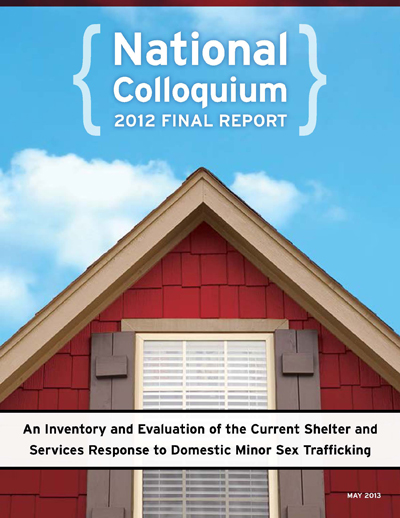
On July 8, a briefing was held in Washington DC, to discuss the results of the National Colloquium on Shelter and Services for Domestic Minor Sex Trafficking Victims. The event was organized by Shared Hope International, and presented by Congresswoman Linda Smith, President and Founder. The live streamed event was held in coordination with Senators Portman and Blumenthal, Co-Chairs of the Senate Caucus to End Human Trafficking; Reps. Ted Poe and Jim Costa, Co-Chairs of the Congressional Caucus for Victims' Rights and Represenitives Jaime Herrera Beutler and Donna F. Edwards, Co-Chairs, and Reps. Kristi Noem and Doris O. Matsui, Vice-Chairs of the Congressional Caucus for Women's Issues. Participants discussed trends and obstacles in establishing treatment facilities for underage victims of sexual exploitation and trafficking.
The National Colloquium Report provides policy makers, government agencies, service providers, and law enforcement with an overview of current services and shelter delivery models. Due to the nature of the crime of commercial sexual exploitation of children, we all know that multiple systems interact with child victims and collaboration is critical among law enforcement, child welfare agencies, and other first responders.
Among the issues discussed was the current status of providers of shelter and victim services for youth victims of domestic minor sex trafficking within the United States, and the glaring lack of beds -there are currently only 226 beds available to youth victims of sex trafficking in the U.S. Also acknowledged were the community-based service providers, which, according to the report, can offer space for up to 1,684 minor victims of sexual exploitation. These numbers are an important indicator that the US has grown in the capacity to provide service to victims, but also have improvements to make. The Executive Director went on the address issues with services and shelters that were identified in the report, one being the geographical disparity between high-traffic areas and the locations of service providers.
The report shows that of practitioners providing direct services reported they receive referrals from juvenile probation from child protective services, and law enforcement. In addition, three national surveys for providers, survivors, and advocates and funders were developed and distributed and over 100 expert individuals and organizations completed the surveys. Responses were collected from 51 organizations, 33 survivors and 18 national advocacy and funding experts. The report includes 26 specific recommendations in 5 categories: Placement and services for identified youth, Licensing and maintaining shelter and programs, Identifying sustainable resources, Programmatic/therapeutic responses, and Safety and security recommendations
Click here to read the full report!
Tuesday, July 2, 2013
Commercial and Billboards in Texas Seek to Impact the Demand for Sex Trafficking
These PSA's and billboards make it clear that when you buy sex you are fueling human trafficking, and we how to see more incentives like this sweeping the country.
Texas has once again taken a great step in the state level fight to end national and global human trafficking. More calls come from Texas to the National Human Trafficking Hotline than any other state, due to the great incentives put into place including the use of billboards and campaign efforts by Huston Rescue and Restore.
The first step to ending human trafficking and modern slavery is to end demand! Please share these resources to help open the eyes of others and see we put an end to the enslavement of innocent men, women and children once and for all.
Friday, March 15, 2013
Fact: Males are Victims of Sex Trafficking
You hear quite a bit about sex trafficking these days, but when you think about it the image of the victim that comes to your mind is that of a female. Sexual violence against males overall has always been a very culturally taboo subject. Regardless of the situations of abuse most male victims do not report their abuse and there are fewer services available to them...and no wonder there is very little mention of them. This lack of mention of male victims in society, by the media has led to what appears as a lack of concern and thus has rendered male victims almost invisible.
The statistics on male victims of sex trafficking are few and far in-between, but that does not mean that they are not out there. If we close our eyes, turn our heads or simply do not see it, it does not mean its not there. This is not a set of isolated cases, nor is it a foreign problem, it is a global problem that stretches from the world of the Bacha Bereesh -“beardless boys”- in Afghanistan to the streets of your very own cities.
Tuesday, December 11, 2012
Modern Slavery News Round-Up
Imagine being a 12-year-old forced to wash dishes and clothes, clean the floors, cook, and other chores, beaten when you've done things wrong. That was the life of Dayanna Denois, and is also the life of many "restavek" children. The term "restavek" is a Haitian Creole word that comes from the French for "rester avec" or "to stay with;" It refers to the practice of parents giving away children they are too poor to look after and often happens to children from rural areas who are sent to stay with wealthier relatives and acquaintances in the hope that they will be given a better life and sent to school.
Human trafficking victims get more protection and services in federal court than in state court
Alex Campbell recruited foreign-born women who were looking to achieve the American dream in Chicago. He made them his victims, branding them with tattoos on their neck and back, declaring them as personal property, forcing them to work long hours with no pay and little food at the Day and Night Spa in labor and commercial sex. Campbell was sentenced to life imprisonment for sex trafficking, forced labor, harboring illegal aliens, confiscating passports and extortion. Four victims testified at the federal trial.
LA Teen Prostitutes Come From Foster Homes A Majority of the Time
The majority of young people arrested on prostitution charges in LA County come from the county's own foster care system, according to county officials. Pimps use child sex workers to recruit fellow foster care children who are currently living in shelters and foster homes. This is according to Supervisor Michael Antonovich, who introduced a motion to establish a task force to investigate sex trafficking in the foster care system. The LA County Board of Supervisors passed the motion two weeks ago. Antonovich's motion reports that the average age of entry into prostitution is 12 years old and that the average life expectancy following entry is seven years, according to the U.S. Department of Justice and the FBI.
Labels:
branded,
California,
Chicago,
child sex workers,
children,
federal trials,
forced labor,
foster care,
Haiti,
Illinois,
LA,
life sentence,
pimps,
prostitution,
protection,
restavek,
sex trafficking,
tattoos
Sunday, August 19, 2012
Another Victory: New State Joins in Vacating Convictions for Victims
Prostitution convictions for victims of forced prostitution and sexual exploitation are sadly all too often common aspects of human trafficking -modern slavery. Recently, Hawaii joined a small group of states who have passed legislation which will vacate prostitution convictions for victims of human trafficking. Hawaii's new law -SB 2576- “allows sex trafficking victims to vacate prostitution convictions from their criminal records by proving they were sexually enslaved”. Additional states with similar legislation include New York, Illinois, and Nevada; New York was the first state to enact such a law. While this is good news for many survivors -who find it increasingly difficult to attain or retain employment due to this such unjust and misunderstood convictions- there are a few criticisms. One argument questions “how useful a bill like SB2576 would be to many victims on a practical level […saying] that many victims are too afraid of their traffickers to testify against them to prove their victim status. Therefore, a vacating conviction law has no value to victims if it requires them to prove their sex trafficking history by testifying against traffickers” (Dale). Unfortunately, it seems that similar issues will arise in many cases of “vacating convictions” laws, as they do with cases of sexual assault and rape. In rape cases, it can be very difficult to prove that the incident occurred, in addition to the psychological turmoil of reliving such a traumatic event. Victims are often accused of provoking their attackers or of lying. The few cases in which it is later revealed that the victim was not actually a victim certainly does not help. In the same instance, victims of human trafficking/modern slavery endure the same fate as victims of rape. Their lawyers must prove, beyond a reasonable doubt, that they were trafficked and the victim has to relive that time in their life. In addition, there is the possible accusation that they are lying or that they were voluntary participants. Regardless of criticisms, many individuals and organizations view SB2576 and similar legislation, as a victory for victims. It is a new change and another chance for them to reintegrate into society with a clean slate. Dale, Youngbee. "Hawaii: New Law Allows Trafficking Victims to Vacate Prostitution Convictions." Washington Times Communities. N.p., 11 July 2012. Web. 27 July 2012.
Subscribe to:
Posts (Atom)