South Sudan sides 'recruit 9,000 children to fight'
More than 9,000 child soldiers have been fighting in South Sudan's brutal civil war, UN human rights chief Navi Pillay has said. Both the army and rebel forces had recruited the children, she said. Ms Pillay said South Sudan faced the threat of a famine, but there was an "apparent lack of concern" on the part of its leaders. She was speaking at the end of a visit to South Sudan, where the conflict has displaced about a million people.
Nigeria girls' abduction: Protest march in Abuja
Hundreds of mainly women protesters have marched through the Nigerian capital, Abuja, to press for the release of 230 schoolgirls abducted by militants two weeks ago. The government should, if necessary, negotiate with their captors to secure their release, a protester said. The Islamist group Boko Haram has been blamed for abducting the girls from their school in Chibok, Borno state. Boko Haram has not yet made any response to the accusation. The group, whose name means "Western education is forbidden" in the local Hausa language, has staged a wave of attacks in northern Nigeria in recent years, with an estimated 1,500 killed in the violence and subsequent security crackdown this year alone.
Sex trafficking in your backyard
Minnesota brings many things to mind — open prairies, 10,000 lakes and Midwestern values. Yet even in America's heartland, the most wretched of crimes, human trafficking, is a growing menace. Last year, the FBI identified Minnesota as one of the nation's 13 largest centers for child sex trafficking. The Women's Funding Network says that monthly, about 200 adolescents are sold for sex there through the Internet and escort services. In 2011, Minnesota courts had nearly 400 trafficking-related convictions.
Human trafficking victim shares her story
Amanda Dobyns said her mother traded her for drugs when she was younger. “She owed her drug dealer several thousand dollars and he told her you can either give me your daughter or pay me the money you owe me,” Dobyns said. It happened when Dobyns was only 13 years old. “Anytime she wanted a fix she would just trade me to him and get her drugs and he and multiple men would rape me,” Dobyns said.
New Hampshire: Human trafficking bill moves to House
The House Criminal Justice and Public Safety Committee unanimously passed a comprehensive human trafficking bill Tuesday, setting the stage for floor action next week. The bill is considered a significant step forward for New Hampshire, which has been lagging behind other states in establishing laws against those who engage in sex and labor trafficking. "This bill contains big advancements that are super important," said Amanda Grady Sexton, public policy director of the New Hampshire Coalition Against Domestic and Sexual Violence. In a national ranking of state sex trafficking laws, the national anti-trafficking organization Polaris Project placed New Hampshire third from the bottom.
Welcome to the Bridge to Freedom Foundation Blog
Thank you for visiting the Bridge to Freedom Foundation (BTFF) blog, where we look forward to bringing you inside information on the inner-workings of BTFF, inside information on our volunteer team and leadership, in-depth coverage of BTFF and partner events, news and happenings from across the globe and so much more.
Learn more about Bridge to Freedom Foundation and how you can help on the BTFF website. We do hope you will subscribe to and follow our blog and please e-mail us at blog@btff.org if you have any feedback, ideas or contributions.
Thank you for your support!
Cassandra Clifford
Executive Director and Founder of BTFF
Showing posts with label modern slavery. Show all posts
Tuesday, April 29, 2014
Friday, April 4, 2014
Facts: 11 Facts About Human Trafficking
2. Trafficking primarily involves exploitation which comes in many forms, including: forcing victims into prostitution, subjecting victims to slavery or involuntary servitude and compelling victims to commit sex acts for the purpose of creating pornography.
3. According to some estimates, approximately 80% of trafficking involves sexual exploitation, and 19% involves labor exploitation.
4. There are approximately 20 to 30 million slaves in the world today.
5. According to the U.S. State Department, 600,000 to 800,000 people are trafficked across international borders every year. More than 70% are female and half are children.
6. The average age a teen enters the sex trade in the U.S. is 12 to 14-year-old. Many victims are runaway girls who were sexually abused as children.
7. California harbors 3 of the FBI’s 13 highest child sex trafficking areas on the nation: Los Angeles, San Francisco and San Diego.
8. The National Human Trafficking Hotline receives more calls from Texas than any other state in the US. 15% of those calls are from the Dallas-Fort Worth area.
9. Between 14,500 and 17,500 people are trafficked into the U.S. each year.
10. Human trafficking is the third largest international crime industry (behind illegal drugs and arms trafficking). It reportedly generates a profit of $32 billion every year. Of that number, $15.5 billion is made in industrialized countries.
11. The International Labour Organization estimates that women and girls represent the largest share of forced labor victims with 11.4 million trafficked victims (55%) compared to 9.5 million (45%) men.
Friday, February 28, 2014
Fact: Average annual return on investment of a slave in 1810 was 15%-20%; today it is 300%-500%
"The average annual return on investment of a slave for the exploiter in 1810 was 15%-20%; today it is 300%-500%, even higher for sex slaves."
-Siddharth Kara Sex Trafficking: Inside the Business of Modern Slavery (2009)
Friday, February 14, 2014
Chocolate Love...
It's Valentine's Day and many people of you are reaching for that tasty and sensual chocolate treat to give to your loved ones. Chocolate has long been associated with romance, but this seductive sweet has a bitter dark side you may not want to think about. This seductive treat has not seduced lovers alone, but those who prey on the innocence of others and lust after wealth. The irony is that chocolate -the happy and love induced sweet, is also source of pain and captivity.
There is a price for this dark and creamy treasure. In Côte d’Ivoire and Ghana, children are often kidnapped from neighbouring Mali and Burkina Faso in order to provide slave labor on cocoa plantations. In Bitter Chocolate, journalist Carol Off describes the conditions in which these child slaves work:
“The farmers were working the young people almost to death. The boys had little to eat, slept in bunkhouses that were locked during the night, and were frequently beaten. They had horrible sores on their backs and shoulders… Farmers were paying organized groups of smugglers to deliver the children to their cocoa groves, while police were being bribed to look the other way.” These children are responsible for climbing cocoa trees, cutting down bean pods, and chopping them open with machetes, which leads to inevitable accidents. They are exposed to hazardous pesticides that they spray without protective equipment. They are fed corn paste and bananas, the cheapest food available, and they’re not paid. When one former child slave was asked what he’d stay to chocolate-eating Westerners, he answered, “When people eat chocolate, they are eating my flesh.” Despite the fact that the cocoa industry’s awful human rights record is now public knowledge, “Big Chocolate” – Cargill, Nestlé, Hershey, Mars, Ghiridelli etc. – have not taken the necessary steps to guarantee that their products are slave-free. Many problems could be alleviated, or at least improved, if these companies paid their workers a living wage, one that is high enough to maintain a basic standard of living that includes education, health care, and savings. A big part of the problem is that Western consumers love eating cheap chocolate so much that they don’t pressure the industry to change. Rather than being viewed as a rare, expensive treat, chocolate has become “a universal luxury – a reasonably priced frivolity for everyone, except those who’ve never heard of it or can’t afford to buy it. Ironically, that unenviable group includes the people who produce its most essential ingredient.” (Bitter Chocolate)
What can you do? The first and easiest thing you can do is read labels. Fair trade is a decent option, as it ensures producers sell chocolate at above-market prices, generating extra income to improve community infrastructure and give a higher quality of life to farming communities. The downside is that certification can be very costly, and is often not affordable for small-scale operations- therefore sometimes you have to do a little research (but then again is that really such a big price to pay?). Please also keep in mind there is more than one label -in 2012, Fair Trade USA split from the International Fair Trade Organization. There is also the Rainforest Alliance stamp, which ensures that farmers are growing cocoa in environmentally responsible ways – protecting shade trees, planting native species, maintaining wildlife corridors, conserving natural resources, and reducing pesticide use.
Chocolate: More and more retailers carry Fair Trade chocolate so just keep your eye out for the Fair Trade label as you shop. You can also purchase special valentines gifts online including heart-shaped chocolates from Divine Chocolate, the sweet and spicy chocolate sampler from Equal Exchange, the Valentine’s Day Heart Box from Sweet Earth Chocolates and a full tub of chocolate hearts of cherry or dark chocolate with raspberry bar from Sjaak’s. Sweet Earth Chocolates Classic Red Velvet Box, ChocoDream Spreads, Kopali Chocolate Covered Cacao Nibs, TCHO “My Heart’s Desire” Adigard 12-Bar Sampler, Alter Eco Dark Velvet Chocolate and sweetriot riotous riotBar gift set. Why not reach outside the box and try Kopali’s Dark Chocolate Covered Bananas.
Learn more and see what products are "safe" by reading our post from last year and checking out all the great resources and links: http://bridgetofreedomfoundation.blogspot.com/2013/02/make-sure-your-valentines-day-is-not.html?spref=tw
Monday, January 20, 2014
Modern Slavery News Round-Up
Activists seek justice for RI worker in HK ‘slavery’ case
The governments of Indonesia and the Hong Kong Special Administrative Region must launch a fair investigation into the alleged torture of 23-year-old Indonesian migrant worker Erwiana Sulistyaningsih by her employer in Hong Kong, activists and workers say. According to local media reports, Erwiana — who is now undergoing medical treatment at a local hospital in her hometown of Sragen, Central Java — might have been abused for around eight months after arriving in Hong Kong in May last year to work for a local family, during which she was also banned from speaking to others. “What happened to Erwiana is not a crime but modern slavery. Shame on the government to have failed to prevent such an incident from occurring,” Anis Hidayah, the executive director of Migrant Care, an NGO focusing on workers’ rights, told The Jakarta Post on Thursday.
Labor, sex traffickers, modern slavery in Colorado
The FBI's Rocky Mountain Innocence Lost Task Force rescued 59 teen prostitutes from flesh peddlers in Colorado this year, up from 49 in 2012. In July, Operation Cross Country, a nationwide sweep that targeted victims of underage prostitution and their pimps, recovered 105 juveniles and bagged 150 pimps in 76 cities. Denver ranked fourth in the number of teens rescued, with nine juveniles, fewer than only San Francisco, Milwaukee and Detroit.
Huge nationwide prostitution ring promised women a luxury lifestyle but subjected them to 'modern-day slavery' where they were branded with bar codes
A San Diego street gang operated a vast nationwide prostitution ring that spanned 46 cities in 23 states, federal prosecutors revealed on Wednesday. The group promised luxury lifestyles to girls and women but instead they were branded with tattoos and bar codes, and treated like slaves. 'The kind of sex trafficking described in this indictment is nothing less than modern-day slavery,' said U.S. Attorney Laura Duffy as she announced racketeering conspiracy charges for 24 people.
Feds: Be Aware Of Human Trafficking Signs As Detroit Auto Show Opens
With the North American International Auto Show opening Saturday at Detroit’s Cobo Center, federal authorities warning the public about several common human trafficking indicators because demand for commercial sex services increases around high-profile events. Agents say human trafficking is one of the most heinous crimes that U.S. Immigration and Customs Enforcement’s Homeland Security (HSI) investigates. In its worst manifestation, human trafficking is akin to modern-day slavery. Victims pay to be illegally transported into the United States only to find themselves in the thrall of traffickers. They are forced into prostitution, involuntary labor and other forms of servitude to repay debts – often after entry in the United States, officials say.
UK family sentenced for keeping slave
A family has been jailed in the UK for keeping a man with learning difficulties as their slave. Craig Kinsella was beaten and made to work 19-hour days for no money by a couple and their son. It was modern-day slavery in a Sheffield suburb. The Rooke family were caught on their own CCTV camera attacking the man they kept enslaved in their garage. The victim was Mr Kinsella, 34, who has learning difficulties.
Friday, January 17, 2014
Fact: Human Trafficking is a $34 Billion Dollar a Year Business
According to ILO (International Labor Organization), the estimated total global profits from Human Trafficking are $34 billion a year 21 billion forced labor 13 billion for sex trafficking More males victims are now being recruited for the labor force.
Monday, January 13, 2014
Modern Slavery News Round-up
How social enterprises are combating modern slavery
It is estimated that nearly 30 million people around the world are trapped in modern slavery while many others have survived human trafficking or are in situations of risk. Social enterprises could offer a sustainable solution to the problem of economic vulnerability that ensnares people in modern slavery. The UK's modern slavery bill, that will tighten laws on human trafficking, was published at the end of last year and will be introduced before the current session of parliament ends next spring. The draft bill briefly mentions that the government will work with businesses to "ensure their workforce and supply chains are not exploited", but does not explain how. In fact there is little mention of the role businesses or charities can play in countering the issue in the whole 62-page document.
Man jailed for six-and-a-half years for keeping vulnerable man a slave
An ice cream business owner who kept a vulnerable man like a slave has been jailed for six-and-a-half years by a judge who said it was staggering that it could happen in modern society. David Rooke forced Craig Kinsella, 34, to live in a garage where he suffered regular beatings and ended up scavenging for food in bins, Sheffield crown court heard. Rooke, 44, admitted falsely imprisoning and attacking Kinsella and was jailed along with his wife Donna, 40, and son Jamie, 19.
Global slavery index researchers welcome constructive criticism
Attempting to measure modern slavery is not for the faint hearted. You're essentially trying to measure something that is hidden, poorly understood and massively under-reported. Nevertheless, the global slavery index approach is to take an estimate based on the best available information, as Free the Slaves co-founder Kevin Bales outlined in a piece for the network in October. The index estimates the size of modern slavery country by country, regionally and globally. It estimates that there are 29.8 million people in some form of modern slavery globally, whether this is a forced marriage or enslavement of workers in brick kilns. Estimates depend in large part on information derived from secondary sources, but also draws upon the limited survey data that is currently available, as well as expert assessment.
Saturday, January 11, 2014
8 Things You Didn’t Know about Human Trafficking Recognizing National Global Human Trafficking Awareness Day – January 11
January 11 is a day to remember a silent population: the victims of human trafficking. Since they can’t speak for themselves, we take a moment to speak out for them. Facts that may be new to you about the underworld of Human Trafficking:
- It is estimated that upwards of 27 million men, women and children are victims of human trafficking – modern day slavery across the globe. That’s more people than the total populations of some countries, like Greece or Ghana.
- Every year, thousands of slaves are trafficked right here in the U.S. It’s a national and international crisis.
- Over 80% of those trans-nationally trafficked are women and children.
- Some 800,000 people against their will are trafficked across international borders each year – and 50% of them are children.
- A slave today costs an average of just $90. Compare that to a slave in 1850 in the southern U.S., with an equivalent cost today of $40,000.
- Slavery is masked by many names: debt-bonded, forced labor, indentured servitude. By any other name it is still slavery.
- Slaves can be found in a multitude of places, from fields to brothels to factories. They can be found in homes or restaurants near you.
- Slavery is not legal anywhere, and yet it happens everywhere.
Tuesday, December 17, 2013
Lisa Kristine Donates Photo for National Global Human Trafficking Awareness Day Poster
We are delighted to announce that Lisa Kristine, world renowned humanitarian photographer, has donated the rights to use one of her human trafficking images on our 2014 National Global Human Trafficking Awareness Day Poster.Awakening compassion and igniting action in a worldwide audience with powerful, broad-sweeping images of courage and tender, intimate portrayals, Lisa elevates significant social causes-such as the elimination of human slavery and the unification of humanity-to missions. Lisa has gained broad recognition for her collaboration with the NGO Free the Slaves. This breathtaking body of work, illuminating human enslavement, is brought together in Slavery, published in 2010. Lisa has received global attention for shining a light on contemporary slavery across media platforms, including CNN and Reuters, speaking at TED events, museums, NGO's, business conferences, colleges and universities.
Last month, Lisa was honored with a Lucie Award for her work as a humanitarian photographer. Bridge to Freedom Foundation is privileged to be able to use one of her moving images of modern slavery, so please stay tuned as we will unveil the 2014 NGHTAD poster in the coming weeks. In the meantime, please visit -and share- Lisa's website to see some of her remarkable work.
Friday, November 29, 2013
Wednesday, November 13, 2013
Tips for Law Enforcement to Efficiently Detect, Prevent, and Deter Human Trafficking
- Train personnel on the indicators of human trafficking and on effective interviewing of potential victims who, in most cases, do not self-identify.
- Educate the public about human trafficking and concentrate on the vulnerable populations of the community.
- Develop government and non-government partnerships to achieve a unified enforcement action against human trafficking while providing aftercare for the victims.
- Collect information and intelligence to identify the criminal networks, traffickers, persons of interest, locations, and financial aspects involved in the illegal trafficking operations. Investigate those people and locations linked to human trafficking and explore prosecution for any subsequent crime.
- Target high risk areas for human trafficking to better utilize limited resources while tracking and assessing activity and enforcing laws.
- High risk areas include brothels, strip clubs, escort services, and massage parlors.
- Use proactive enforcement during the peak hours in and around locations linked to human trafficking.
- Develop informants from individuals who are arrested and use the information to further the investigation into trafficking networks.
- Explore the use of modern technology and science to aid in the investigation, evidence collection, and prosecution efforts.
- Seize assets to hinder and disrupt individuals and organizations involved in human trafficking. Prosecute the defendants and publicize success stories.
Read more: http://communities.washingtontimes.com/neighborhood/speaking-out/2013/oct/30/ten-tips-law-enforcement-decrease-human-traffickin/#ixzz2kYi7fuev
Friday, October 18, 2013
Fact: UK Anti-Slavery Day, October 18th
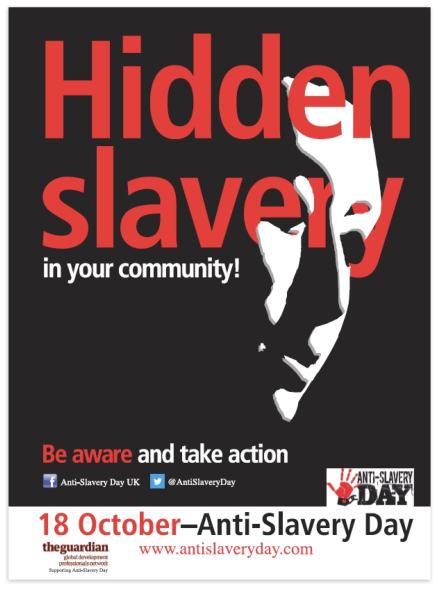
Today the United Kingdom celebrates, Anti-Slavery Day, which falls on 18 October each year. The day provides an opportunity to draw attention to the subject and to pressurize government, local authorities, public institutions and private and public companies to address the scale and scope of human trafficking.
The Anti-Slavery Day Bill became law in 2010. It was introduced in Parliament as a Private Members Bill by Anthony Steen MP for Totnes, South Devon, in 2010 and passed through both Houses, unopposed although amended. The bill defines modern-day slavery as child trafficking, forced labour, domestic servitude and trafficking for sexual exploitation.
Wednesday, October 16, 2013
Walking for Freedom
The DC UNBOUND Stop Modern Slavery Walk has become somewhat of an institution within the local anti-slavery movement. This event brings together survivors, activists and non-profit professionals, corporate partners, as well as interested members of the general public. Hosted on the grounds of President Lincoln's Cottage on October 5th, this year's walk created a remarkable environment to interact with people who already find themselves deeply invested in the cause, or who are interested in getting involved. How apt for this anti-slavery event to take place in the gardens of the President most remembered for the emancipation of slaves?
From moving personal accounts by survivors to professionals who have fought in this arena for many years, this event was proof of the fact that this movement has no shortage of devoted warriors. Captivating modern dance and percussion performances made for an enjoyable day. At the BTFF promotional table, we had some great interactions with people from all walks of life. We had the opportunity to touch base with survivors, other non-profits in the field, as well as to recruit new volunteers who are excited about the work we do. The enthusiasm and drive to end modern slavery displayed left one positive about this movement and the great strides that will be made in the future.
Friday, October 11, 2013
International Day of the Girl Child
Today Bridge to Freedom Foundation (BTFF) is proud to celebrate the second annual International Day of the Girl Child. Enacted by the United Nations in 2011, this day offers an opportunity to highlight gender inequality and the fulfillment of human rights for all women and girls -including the elimination of violence.
The International Day of the Girl Child provides not only everyone at BTFF a greater platform to raise our voices and improve the lives of women and girls around the globe, but for you to join us and make your voice heard. It is that reason BTFF is proud to announce the launch of our Violence Prevention Program on this very special day dedicated to girls around the world. Please help us ensure that girls are not only able to lead thriving lives, but are able to walk through their daily lives aware and empowered to fight against violence!
We hope you will join us in honoring the Day of the Girl Child, as well as October being Domestic Violence Prevention Month, by donating to our Violence Prevention / Self-Defense fundraising campaign. Please click here to see how you can sponsor a free 3 hour workshop for a survivor.
Labels:
child brides,
child marriage,
child sex slavery,
child trafficking,
domestic minor sex trafficking,
forced marriage,
gender equality,
gender-based violence,
International Day of the Girl Child,
modern slavery
Friday, October 4, 2013
FACT: A human trafficker can earn 20 times what he or she paid
A human trafficker can earn 20 times what he or she paid for a girl. Provided the girl was not physically brutalized to the point of ruining her beauty, the pimp could sell her again for a greater price because he had trained her and broken her spirit, which saves future buyers the hassle. A 2003 study in the Netherlands found that, on average, a single sex slave earned her pimp at least $250,000 a year (Skinner, E. Benjamin. 2008. A Crime So Monstrous: Face-to-Face with Modern-Day Slavery. New York, NY: Free Press).
Wednesday, October 2, 2013
Modern-Slavery News Round-Up
All Hands on Deck: Renewing the Call to Combat Human Trafficking
Spet. 25: One year ago today, President Obama announced the Administration’s commitment to lead the fight against human trafficking during a seminal speech at the Clinton Global Initiative Annual Meeting. ...Over the past year, we’ve made great strides and increased our efforts in order to realize the President’s vision. However, we still have so much more to do. The President said in his remarks one year ago, “It ought to concern every person, because it is a debasement of our common humanity. It ought to concern every community, because it tears at our social fabric. It ought to concern every business, because it distorts markets. It ought to concern every nation, because it endangers public health and fuels violence and organized crime. I’m talking about the injustice, the outrage, of human trafficking, which must be called by its true name – modern slavery.”
Michigan: Human trafficking: 19-bill package aims to curb 'modern day slavery' in Michigan, help victims Michigan state Sen. Judy Emmons on Thursday unveiled a 19-bill package intended to crack down on human trafficking and offer help to victims of a crime that many call a form of "modern day slavery." The bipartisan package, to be formally introduced next week, features bills that would provide safe harbor for victims, eliminate the statute of limitations for trafficking offenses, allow victims to sue their captors and enable a prosecutor to utilize wire tapping while building a criminal case.
Florida: Statewide human-trafficking initiative focuses on children A new statewide initiative championed by Florida Attorney General Pam Bondi aims to end human trafficking by encouraging parents and children to discuss the dangers of talking to strangers online. The "From Instant Message to Instant Nightmare" crusade, unveiled Friday, includes billboards, mall displays and bus-shelter posters asking parents and children to educate themselves about sex traffickers who target children, tweens and teens online.
A Bold Plan to Aid Sex-Trafficking Victims As understanding of the cruel dynamics of sex-trafficking has grown in recent years, a consensus has emerged among criminal justice professionals that it makes more sense to treat people charged with prostitution as the exploited and abused victims a vast majority are, rather than as criminals. An important new initiative by New York State’s chief judge, Jonathan Lippman, aims to put that humane insight into practice. A handful of cities across the country, including Baltimore and Phoenix, have specialized courts that deal with sex-trafficking offenses. On Wednesday, Judge Lippman announced the creation of the nation’s first statewide system of specialized criminal courts to handle prostitution-related offenses and make services available to help sex-trafficking victims escape their abusive situations and forge new lives.
Sunday, September 29, 2013
Happy National Coffee Day: Have a fair trade cup of joe today!
In the morning as that alarm clock blares I shoot out of bed like bullet with a sudden, mysteriously founded burst of energy, as I quite literally whack my alarm off and scramble to my morning routine. But that sudden burst of energy goes as quickly as it came and I know the only thing to get my now heavy feet moving again is a strong cup of coffee, which like magic turns me human again. So if your anything like me you cannot live without one of the worlds most traded commodities, but for me each sip comes with a secondary level of comfort in knowing that my 'life's water' is slave and child labor free, as I drink nothing-less than fair trade coffee.
Child labor and slavery continues to plague the coffee industry, forcing children to often work to harvest what will soon become your cheap cup of Joe you sip as you trudge through the day. Child labor in the agricultural industry consists of children being bought and sold as slaves or bonded laborers, as migrant or estate workers usually with their family. Many children work for commercial farms and plantations that produce our commodities and are estimated to be 7-12% of the work force. Besides coffee children are often found as labors in the harvest of cocoa, coconuts, cotton, fruit and vegetables, jasmine, palm oil, rubber, sisal, sugar cane, tea, tobacco, and vanilla.
According to the ILO, over 132 million children, aged 5-14 years old, work in agriculture around the world, they are just a segment of an the estimated 246 million child laborers around the globe. UNICEF estimates that some 200,000 children are victims of trafficking each year in West and Central Africa alone, for the purpose of working in the supply chain for products such as; cocoa and coffee. Global March Against Child Labor estimates that one in every eight children from 5 to 17 years old, some 179 million, work in the worst forms of child labor. These children are placed in hazardous working conditions in order to ensure that we have our sweet treats, it is truly a bittersweet story.
Fair Trade is everyone's issue, it is more than looking at the world through a lens of more organic and healthy food, it is more than a fair wage for farmers…Fair Trade is the way to a sustainable future for all of the worlds children. So join the fight for children across the globe, and join your global citizens for coffee with a cause and drink Fair Trade today!
Take the opportunity to learn about Fair Trade with your children and go on a few of the great sites out there that have games and resources for kids, such as Oxfam's Cool Planet and Kidz @ Work . Please see my Fair Trade and Slave Free Links for more information.
Please also see previous posts on Child Trafficking, Child Labor and don’t forget to check out the following resource pages:
Monday, September 9, 2013
Modern Slavery News Round-Up
Demands grow for child guardians to end shame of modern slavery in the UK
Safe accommodation could stop suspected victims being found by traffickers, say experts.The number of children identified as potential victims rose by 12% last year, according to a recent report by the UK Human Trafficking Centre. It identified 2,255 potential child victims – up from 2,077 the previous year. Advocates of guardianship say it would ensure secure housing, education and legal support to stop trafficked children falling back into the hands of their exploiters.
Nail bars: modern-day slavery in plain sight?
...the beauty industry was one of the most resilient and dependably priced of all throughout the latest recession – nail-care businesses and lipstick sellers in particular. But it turns out that there may be another, far darker reason for the rise of the affordable manicure in the UK of late. A report by the Sunday Times (paywalled link) this week presented evidence about nail salons staffed by illegal immigrants, specifically from Vietnam. According to the report, industry insiders estimate that there are 100,000 Vietnamese manicurists working in the UK, despite only 29,000 Vietnamese-born migrants officially being registered in census data. [Questions raised below by commenters over these figures have been addressed in our Reality Check blog – see footnote.] It alleges that some of these illegal migrants are victims of "what appears to be a human-trafficking network" and that they are sometimes forced to work as prostitutes as well as manicurists. According to the latest numbers from Eurostat, 80% of human trafficking victims are female.
The economic case for ending slavery
Instead all of us in the anti-slavery organisations must start working together to effectively make the case to governments and the private sector of the economic benefits of eliminating slavery, over and above the unarguable moral case to end this atrocity. $32bn (£21bn) in annual profits sounds impressive doesn't it? Who wouldn't be happy with such huge profits? The problem is, that is the estimate of how much criminals make from modern slavery every year (pdf). It's a powerful statistic, and one of the most commonly cited. But it is becoming increasingly clear that focussing on these criminally generated profits frames the problem wrongly, and risks undermining effective policy action to end this atrocity.
Wednesday, August 28, 2013
2013 State Ratings on Human Trafficking Laws
The Polaris Project has rated all 50 states and the District of Columbia based on 10 categories of laws that are critical to a basic legal framework that combats human trafficking, punishes traffickers and supports survivors. 39 states passed new laws fighting human trafficking in the past year and as of July 31st they were rated (Tier 1). The states of New Jersey and Washington have perfect scores, meaning that they have governmental laws the fulfill all 10 categories and large improvements have been made to Arkansas, Wyoming, Mississippi, and New Jersey. Ratings are showing that 32 States have passed significant laws to combat Human Trafficking and should continue to take additional steps to improve and implement its laws(Tier 1), 11 States and DC have passed numerous laws to combat human trafficking (Tier 2), 6 States have made nominal efforts to improves laws to combat human trafficking and should take major steps{Tier 3) , and 1 state has not made legal effort to enact a basic legal framework to combat Human Trafficking and should actively work to improve Laws.
Read More.
Monday, August 26, 2013
Modern Slavery News Round-Up
Legal Blow for Families of Slain Nepali Laborers
U.S. court rules that lawsuit against defense contractor KBR over alleged trafficking & death of 12 Nepali men will go to trial in 2014 - court dismisses some claims against KBR but others will proceed. Supreme Court precedent leaves little legal ammo for the families of Nepali laborers who were executed after a defense contractor allegedly trafficked them into Iraq, a federal judge ruled. Ramchandra Adhikari is the lead plaintiff in the 2008 action alleging that U.S. military contractors duped 13 Nepali men into indentured servitude. With promises of a $500 monthly salary, many of the men allegedly believed they would be working at a luxury hotel in Jordan. When they learned that they were actually on their way to Al Asad Air Base in Iraq, the large brokerage fees they owed allegedly kept the men from turning back for home, according to the complaint.
South African Bill helps tackle human trafficking
The Western Cape has seen a spike in the number of people freed from the clutches of human traffickers over the past few months. The introduction of specialized units focusing on human trafficking syndicates in the Western Cape has seen at least 13 cases being investigated, eight of which are in court. And nine women or girls have been rescued in the past two and a half years, according to police. But despite these strides, there have been no convictions to date. At the end of last month, the Prevention and Combating of Trafficking in Persons Bill was signed into law, giving the country for the first time a statute dealing specifically with human trafficking. It carries a maximum penalty of R100 million or life imprisonment, or both, if convicted. Until now, the law dealing with trafficking has been fragmented.
N.J. Sex Trafficking Law Trips on Speech Grounds
New Jersey cannot enforce a new human-trafficking law that opponents say would criminalize the indirect publication of sex ads depicting minors, a federal judge ruled. In a federal complaint filed June 26, the Internet Archive claimed that New Jersey's Human Trafficking Prevention, Protection, and Treatment Act "would impose an intolerable burden on free speech." "Because of its vague and expansive language (e.g., 'indirectly' 'causes' 'to be displayed' an 'implicit offer'), the law could be applied to any web site that provides access to third-party content, including user comments, reviews, chats, and discussion forums, and to social networking sites, search engines, Internet service providers, and more," the nonprofit digital library claimed. Village Voice Media's Backpage.com LLC moved for a preliminary injunction the same day, and the two suits were later consolidated.
Anti-slavery group calls for boycott of 2022 Qatar World Cup
Evidence is increasing of forced labor in the Qatari construction industry responsible for building the World Cup infrastructure for 2022, Aidan McQuade, the director of Anti-Slavery International told EurActiv. “If that is borne out I think it would be an extremely sad state of affairs,” he said. “It would be a dreadful pity and an enormous shame on all of us if we are prepared to participate in a world cup that has been brought to us by slavery.”
Subscribe to:
Posts (Atom)
46T$7GP2D%5BT9T9E8.jpg)

%7B17E%5D%7BMZ0$7SY$(SZ%5D8.jpg)