Welcome to the Bridge to Freedom Foundation Blog


Thank you for visiting the Bridge to Freedom Foundation (BTFF) blog, where we look forward to bringing you inside information on the inner-workings of BTFF, inside information on our volunteer team and leadership, in-depth coverage of BTFF and partner events, news and happenings from across the globe and so much more.

Learn more about Bridge to Freedom Foundation and how you can help on the BTFF website. We do hope you will subscribe to and follow our blog and please e-mail us at blog@btff.org if you have any feedback, ideas or contributions.

Thank you for your support!
Cassandra Clifford
Executive Director and Founder of BTFF
Showing posts with label child marriage. Show all posts

Friday, November 1, 2013

Fact: Domestic Violence and Human Trafficking Often Happen to the Same Victim


We have quickly been flying through the Fall season, also the season football and awareness months. October is, was, Domestic Violence, established in 1995 when several organizations, including the Family Violence Prevention Fund and the National Coalition Against Domestic Violence united to raise awareness against this growing -and most often silenced- problem.

Why is a human trafficking organization talking about domestic violence? Human trafficking and domestic violence can occur on a continuum of violence, and the dynamics involved in human trafficking are frequently interwoven with those of domestic violence. This occurs mo Individuals who have suffered violence and discrimination in their countries of origin based on their sex, gender identity, sexual orientation, or dysfunctional family situations are often more likely to overlook the risks of unsafe migration, thus increasing their vulnerability to human trafficking. Traffickers also frequently exploit the already lowered self-esteem of trafficking victims who have experienced abusive family lives. Conversely, trafficking survivors are often vulnerable to future incidences of domestic violence.

The following are examples of cases where domestic violence and human trafficking can manifest together on the basis of the same set of facts:

  1. Involuntary servitude in marriage: Cases where traffickers force their spouses to perform services and labor, such as domestic work, working at family businesses, or sex work. These traffickers may also physically and sexually abuse their spouses, as well as threaten them with immigration and legal consequences. 
  2. Forced prostitution and sex work: Cases where individuals are recruited into sex trafficking by traffickers feigning love interest in them. The cases may involve fraudulent courtship, sexual assault, and then a distinct pattern of domestic violence to control or convince the victims to engage in sex work. 
  3. Other forced labor: Cases where individuals are trafficked by other family members (besides in

Friday, October 11, 2013

International Day of the Girl Child

Today Bridge to Freedom Foundation (BTFF) is proud to celebrate the second annual International Day of the Girl Child. Enacted by the United Nations in 2011, this day offers an opportunity to highlight gender inequality and the fulfillment of human rights for all women and girls -including the elimination of violence.

The International Day of the Girl Child provides not only everyone at BTFF a greater platform to raise our voices and improve the lives of women and girls around the globe, but for you to join us and make your voice heard. It is that reason BTFF is proud to announce the launch of our Violence Prevention Program on this very special day dedicated to girls around the world. Please help us ensure that girls are not only able to lead thriving lives, but are able to walk through their daily lives aware and empowered to fight against violence!

We hope you will join us in honoring the Day of the Girl Child, as well as October being Domestic Violence Prevention Month, by donating to our Violence Prevention / Self-Defense fundraising campaign.  Please click here to see how you can sponsor a free 3 hour workshop for a survivor.

Thursday, September 12, 2013

Death of Child Bride in Yemen an All too Familiar Story


The recent story on the child bride in Yemen who was killed has me fired up again, as over the years I have written many times on child marriage across the globe.
"Al Nahar, Lebanon, has reported that an eight year old child bride died in Yemen on her wedding night after suffering internal injuries due to sexual trauma. Human rights organizations are calling for the arrest of her husband who was five times her age" (albabwa).
 Not only have I written countless times on the global plague of child marriage, but even more I have reported on Yemen numerous times since at least 2008, when I published  "Girls in Yemen Forced to Marry too Young".

In 2010 I even reported on a story that almost mirrors the one that is causing global outcries as we speak,  when a 12 year-old child bride died; "Child Marriage in Yemen Turns Deadly" and "Yemen Fights to Ban Child Marriage" just to name a few.

I am truly fired up over this one -not simply because of the shocking and unspeakable nature of the child's death, but as we have sought to speak out for so many years to only have the cries of child brieds in Yemen and across the globe continue to be silenced.  We cannot stand by one more day and ignore these innocent children, most of whom do not have their stories told and not only cry in silence, but who's deaths gain no tears.

 Stay tuned I have a lot more to come and will be writing a new post with a fresh perspective shortly.

Monday, March 11, 2013

Modern Slavery News Round-Up

Third of girls in 42 countries forced in to child marriages
More than one-third of all girls are married in 42 countries, according to the U.N. Population Fund, this in reference to females under the age of 18. The highest number of cases occurs in some of the poorest countries, the agency figures show, with the West African nation of Niger at the bottom of the list with 75 percent of girls married before they turn 18. In Bangladesh the figure is 66 percent and in Central African Republic and Chad it is 68 percent. Child marriage is not common in South Africa, where prosecutors are investigating what charges can be brought in the case of a 13-year-old epileptic girl who was forced to leave school and marry a 57-year-old traditional healer in January. Reducing child marriages is key to achieving U.N. millennium goals to improve child mortality and reduce maternal deaths, according to Malawi's Health Minister Catherine Gotani Hara. She said teen pregnancies accounted for up to 30 percent of maternal deaths in that southern African country.

Human-trafficking bill clears key hurdle in Kentucky legislature
A House bill that would stiffen state penalties for human traffickers and provide more services to trafficking victims, recently took a major step toward becoming law. The measure would add more teeth to Kentucky's 2008 human trafficking law. It would provide more training for law enforcement on human trafficking, allow police and prosecutors to seize assets of those involved in human trafficking, and earmark money from the seized assets to pay for victim services. The bill also allows human trafficking victims to receive treatment rather than jail time, a provision sometimes referred to as safe-harbor protection.

The proposal also would require people to report human trafficking to authorities, an essential provision of the bill, said the bill's sponsors, Rep. Addia Wuchner, R-Burlington, and Rep. Sannie Overly, D-Paris. Since 2008, advocates have treated 101 human trafficking victims, but there have been only 18 prosecutions — 16 using state law and two using federal law. The vast majority of those cases involve the selling of Kentucky children for sex by someone they know.

MS-13 Gang Members Sentenced to Prison on Sex Trafficking Charges
Jonathan Adonay Fuentes, aka “Cheesy” and “Crazy Boy,” 21, of Clinton, Marlyland, was sentenced to 120 months in prison, followed by five years of supervised release, for sex trafficking a juvenile female as part of a prostitution enterprise operated by the violent street gang Mara Salvatrucha Thirteen (MS-13). According to court documents, Fuentes assisted his fellow MS-13 gang members from the fall of 2009 through the spring of 2010 run a prostitution ring that specialized in selling juvenile girls for commercial sex. Fuentes admitted in court that he transported a teen girl within Virginia and Maryland to engage in sex with clients.

This case was investigated by the FBI’s Washington Field Office, with assistance from the Fairfax County Police Department and HSI, all of whom participate in the Northern Virginia Human Trafficking Task Force. Assistant United States Attorneys Zachary Terwilliger and Patricia T. Giles are prosecuting the case on behalf of the United States.

Support bills to fight human trafficking in Connecticut
Connecticut is moving on several parallel tracks when it comes to serving children. Medical, legal, housing and social services are provided through a number of state and non-profit agencies. Several organizations are raising awareness of trafficking with the general public and training law enforcement officials, judges, school officials and others to recognize and report possible cases of human trafficking. And in recent years Connecticut's Legislature has responded by passing several laws related to the care and custody of child victims.

With three bills in total being pushed, one is Senate Bill 45, An Act Concerning Sexual Exploitation and Human Trafficking, is sponsored by Sen. Martin Looney of New Haven. Among other things, it calls for the, "... superior court to freeze the assets of an accused trafficker and require truck stops and liquor permit premises to post the telephone numbers for state and federal anti-trafficking hotlines." 79 cases of potential human trafficking incidents at truck stops across the country were reported in 2011, the latest year for which statistics are available. Although Connecticut is not among the top five states for trafficking incidents at truck stops, all you have to do is travel up and down I-95 in the early morning hours to realize the number of truckers that can be reached with prevention information.

Senate Bill 149 and House Bill 6136,  are the other two bills which appear to be legislation that remit harsh punishment for those persons who are victims of human trafficking. Considering that many of the participants involved in these actions are young and unaware as to how to escape, these bills are an attempt to offer them an escape and new life. All the bills stated are waiting for public hearings to be scheduled.

Friday, March 8, 2013

FACT: More than 140 Million Girls will marry between 2011 and 2020


Between 2011 and 2020, more than 140 million girls will become child brides, according to United Nations Population Fund. Of the 140 million girls who will marry before the age of 18, 50 million will be under the age of 15. Despite the fact that 158 countries have set the legal age for marriage at 18 years, laws are rarely enforced since the practice of marrying young children is upheld by tradition and social norms. Child marriage, which has existed for centuries, is a complex issue, rooted deeply in gender inequality, tradition and poverty. The practice is most common in rural and impoverished areas, where prospects for girls can be limited. In many cases, parents arrange these marriages and young girls have no choice.

Friday, February 8, 2013

Myths and Realities of Human Trafficking


The reality of Human Trafficking is that it occurs in nearly every country and its networks are vast and difficult to investigate. According to the United Nations, there are between 27 and 30 million slaves in the world. The U.S. State Department cites that 600,000 to 800,000 people are trafficked across borders every year, but these numbers are often under-reported and victims are usually hidden, meaning that real statistics are hard to substantiate. This also means that there is a vast amount of incorrect information out there, which fuels the myths about human trafficking.

The most common myths are listed below and are further discussed by a contributor to Forbes' The Daily Muse:
  1. Myth - Human Trafficking and Human Smuggling Are the Same
  2. Myth - Most Traffickers Are What the Movies Show You
  3. Myth - Human Trafficking Only Refers to Forced Prostitution
  4. Myth - Only Women Are Trafficked
  5. Myth - Everyone Trafficked is Kidnapped or Deceived
  6. Myth - Trafficking Only Happens in Other Countries, Not in the United States
While the quest to better understand human trafficking seems a formidable task, the more you learn the more you are armed with the facts to better educate yourself and others, while being better equipped to take action against this global problem that reaches to our very own neighborhoods.

Sources: Forbes, The Daily Muse, "Human Trafficking: The Myths and The Realities"

Monday, February 4, 2013

Modern Slavery News Round-Up

In Limpopo, the system fails a young girl of thirteen who should be at school, but is sold off as a child bride to a 57-year-old sangoma, a traditional healer, by her struggling single mother of five to pay off supposed mounting bills. Child marriage continues to plague South Africa as in this case where the young child's rights are not protected by the courts who let off the sangoma once it was learned that the family had consented to the marriage.

China's child abduction by traffickers hard to curb leading officials and parents to social media
Despite authorities cracking down over the past two decades, child abduction is tough to eliminate. Officials claim the problem has become less prolific, but given the inconsistencies of data reporting, this is hard to substantiate. But Deng Fei, a Beijing-based journalist and prominent campaigner on behalf of victims and their families, believes the number of children being abducted is decreasing. Social media may have helped to reduce the crimes as in recent years, parents and activists have been using websites and microblogs to share information about cases and draw public attention to child abduction. Their efforts put pressure on the police, who have responded such as Chen Shiqu, the police official in charge of anti-trafficking, who has an account on Sina Weibo, one of China’s most popular microblog services. His account has 3.4m followers.

Syrian Refugee Women Exploited for Marriage
Lina Al Tiby, a Syrian activist living in Cairo, runs a support network for Syrian women refugees; helps them adapt to life in Egypt; and tries to persuade them not to allow poverty to push them into sex work or unwanted marriage. Arriving in Egypt with little more than the clothes they are wearing, some Syrian women see marriage as the only means of survival. "Egyptian men tell Syrian women they will marry them to help them and their families, but… can’t these men help Syrian women without marrying them?" said Al Tiby.

Eliminating human trafficking from the global business landscape
Businesses may unknowingly be associated with the crime of human trafficking when their suppliers, subcontractors, or partners supply materials or products that have been produced by trafficked persons. “In today’s globalized world, the risks of human trafficking in supply chains are significant throughout economic sectors and affect all States,” says Joy Ngozi Ezeilo, UN Special Rapporteur on trafficking in persons...Ezeilo recommends that all global businesses commit themselves to the UN Guiding Principles on Business and Human Rights and become signatories to the UN Global Compact. Ezeilo also urges businesses to exercise due diligence and conduct a risk assessment for their entire production chain in order to eliminate risks of human trafficking in their operations.


U.S. Agents Rescue Sex Slaves Through Data Fusion
Data-mining is proving a key tool for U.S. law enforcement to free sex slaves and to convict human traffickers involved in the $32 billion industry. Immigration and Customs Enforcement (ICE) have rescued sex slaves by using software that identifies geographic locations by syncing financial transactions, phone records and other discordant data, ICE officials said at a Symposium to address immigration-related crime to technology companies; senior federal officials; and actress Mira Sorvino, the United Nations Goodwill Ambassador to combat human trafficking. Angie Salazar, an ICE section chief who investigates human smuggling and trafficking, confirmed that ICE was able to find victims of trafficking by using data to look for trends. Palantir, a data company that assists many U.S. intelligence agencies, helps ICE with investigations by flagging individuals and organizations.


Monday, October 15, 2012

Modern Slavery News Round-Up

Child marriage at heart of today's global day for girls 
World leaders are joining United Nations agencies today in calling for an end to the practice of child marriage on the first International Day of the Girl. Ideas for action and myriad events -- including several dozen as part of the Girl Up campaign -- are planned worldwide, where one out of seven girls is married before age 15. "While the oppression of girls perpetuates a cycle of poverty, the empowerment of girls has a ripple effect that strengthens families, communities, countries, and ultimately the world," writes Kathy Calvin, CEO of the United Nations Foundation. 

Afghan child brides under UN spotlight
Greater efforts must be made to protect girls in Afghanistan, where nearly half are married as child brides and almost one in six weds before they turn 15, the United Nations said Thursday. "Early marriage is a fundamental violation of human rights and impacts all aspects of a girl's life," a group of UN organizations said in a statement to mark the International Day of the Girl Child...The UN group, including the children's and women's organizations as well as the Afghan mission, said there was a strong link between the age of a mother and maternal death. Despite progress in the past 10 years, the UN says Afghanistan's maternal mortality rate is still 327 per 100,000 live births -- one of the worst in the world. "Girls aged 10-14 are five times more likely to die in pregnancy or childbirth than women aged 20-24," the statement said. The UN points to a link between access to education and the prevention of early marriage.


Well, Uttara from West Bengal was 12 years old when her father fixed her marriage. He even paid the groom's side 2000 rupees. An impoverished farmer, he had to sell a goat and trees to raise the dowry. This may seem an image from the past - yet, this is a common reality all over the country. Close to half the girls in India are married before 18 years of age. In Bihar, Rajasthan and West Bengal, child marriage concerns 3 out of 5 girls. India has the highest absolute number of child brides - about 24 million. This represents 40% of the 60 million child marriages globally.

Islamists in Mali recruit, pay for child soldiers
Across northern Mali, Islamists have plucked and paid for as many as 1,000 children from rural towns and villages devastated by poverty and hunger, the Associated Press has found in several dozen interviews with residents, human rights officials, four children or youth and an Islamist official. The AP also saw several other children with machine guns half their size strolling down the streets in Timbuktu, where Westerners can no longer go because of the threat of kidnapping. The interviews shed new light on the recruitment practices of the Islamists, including first-hand accounts of how much money is being offered to poor youth and their families to join. They also provide evidence that a new generation in what was long a moderate and stable Muslim nation is becoming radicalized, as the Islamists gather forces to fight a potential military intervention backed by the United Nations.

Senate OKs harsher anti-trafficking bill
Attempts to commit various human trafficking-related activities such as recruitment, selling and transporting persons are now crimes under a new Senate-backed bill, which has been unanimously approved on third and final reading. The Expanded Anti-Trafficking of Persons Act of 2010 or Senate Bill No. 2625, extending the original anti-trafficking law or Republic Act 9208, imposes harsher panalties on attempted trafficking and encourages state officials, not-for-profit entities and the media to publicize the identities of accused traffickers. Senate President Juan Ponce Enrile urged President Benigno Aquino III to fast-track the signing of the measure.

According to a growing list of religious groups, feminists, celebrities and policy makers, adult classifieds website Backpage.com is profiting from one of the ugliest crimes on the planet: sex trafficking. Backpage’s critics say they are facilitating sex slavery and should shut the site down. New York Times writer Nick Kristof pressured Goldman Sachs to unload its shares in Village Voice Media overnight (and at a $30 million loss) in March. In July, Washington State introduced a legislative attack on CDA230 that aims to make websites like Backpage criminally responsible for third-party content posted by minors – a move that put the EFF on the offensive on behalf of the Internet Archive, Senior Staff Attorney Matt Zimmerman says, to make sure the legislation “doesn’t cross the line to the government throwing people in jail for what their users do.”

Debt bricks in Pakistani 'slaves'
One does not always need a time machine to travel into the past - a visit to a typical brick kiln in Pakistan's Punjab province is enough to evoke a time when human beings were traded like animals and slavery was rampant. Overburdened by loans, generation after generation of workers, totaling about 4.5 million spread across 18,000 kilns around the country, toil for nothing more than the promise of freedom. Ata Muhammad (28) and his wife work for 18 hours a day at a kiln in the outskirts of Lahore, where they are paid 450 rupees (US$4.80) per 1,000 bricks, irrespective of how long it takes to complete the task. According to estimates from the labor department, it takes a standard family of five, including children, a whole day to make 1,000 bricks.

Experts to study region's gangs, sex trafficking
A trio of local professors have received a $399,000 federal grant to research the scope and nexis of gang activity and sex trafficking in the region. The three-year study, entitled “Measuring the Extent and Nature of Gang Involvement in Sex Trafficking in the San Diego/Tijuana Border Region,” will bring together Point Loma Nazarene University’s professor of cultural anthropology Jamie Gates, University of San Diego’s assistant professor Ami Carpenter and San Diego State University’s professor of criminal justice Dana Nurge. The project will begin in January. The National Institute of Justice has begun funding research on trafficking across the country in recent years in an attempt to understand the scope of the problem. Experts at the federal agency say much more work is needed on assessing how much trafficking goes on, how it works and who are the perpetrators and victims in the United States.

Thursday, October 11, 2012

International Day of the Girl Child

Earlier today, our Executive Director, Cassandra Clifford posted on the Foreign Policy Association's Children blog about the struggles of girls around the world and the need to end child marriage.

She stated that for millions of little girls across the world, childhood is brief. It is estimated that 10 million girls a year worldwide, the majority in sub-Saharan Africa and South Asia, are married under the age of 18, some as young as seven or eight. According to UNICEF, more than 40% of the world’s child marriages occur in India. There are some 60 million children who have been forced to enter into marriage and the numbers will only continue to rise if gender inequality is not made a global priority.

This year, the fight against child marriage was made a priority by ‘The Elders’, a coalition of prominent retired statesmen that includes Nobel Peace Prize winners and former heads of state, who launched a campaign against the practice. Their effort, Girls Not Brides, was formally launched at the 2011 Clinton Global Initiative meeting in New York and has now gained the support and backing of many other global foundations.

One major front of this battle is India. According to The State of the World’s Children 2012 report released by UNICEF last Wednesday, 22% of women between 20 and 24 in India gave birth to a child before they turned 18. Furthermore, 45 out of every 1,000 babies are born to mothers between the ages of 15-19 years old. The report’s shocking statistics also showed that 57% of male adolescents (15-19 years old) and 53% of female adolescents thought a husband was justified in beating up their wives under certain circumstances.

Read the rest of this post by our Executive Director, Cassandra Clifford on the Foreign Policy Association's Children's blog here.

Wednesday, October 10, 2012

Modern Slavery News Round- Up

Changing the culture of child marriage in Malian refugee camps – mission impossible?
When the Taureg fled the fighting in north Mali into neighbouring Burkina Faso they brought part of their culture with them – the practice of child marriage. When one raises the question of early childhood marriage in the refugee camps they close ranks and shy away from the subject. “It is taboo to discuss child marriage,” says Fatimata Nabias-Ouedraogo, Plan Burkina’s Child Protection Advisor. “If we notice a young girl in the company of a man and we ask who this man is, they would say ‘Oh, he’s a friend’. We know that he might in fact be either the husband or fiancé who is looking over her.” In the Taureg culture, early marriage is seen as mechanism to prevent the girl from yielding to temptation to have sex outside of marriage. To do so – or to become pregnant – would be akin to an unpardonable sin. Nabias-Ouedraogo says there are numerous health, social welfare and economic reasons why early marriage is a bad thing.


An online game is gaining popularity on Facebook for not merely amassing points, but also creating social good. "Global Good Challenge," launched by the United Nations Foundation, offers chances to win prizes -- such as tickets to the MTV Video Music Awards and VIP passes to a Lady Gaga show -- for taking social action online and in the real world to help combat global issues such as child marriage, disease and poverty. "Instead of donating money, we want people to donate their social media influence," says the game's creator, Zaw Thet. Check out the Global Good Challenge here: www.unfoundation.org/features/globalgood/

UN Foundation executives are singled out for work
Among the executive honorees on Variety's Women's Impact list are Elizabeth Gore and Dani Zapotoczny of the United Nations Foundation, who lead large-scale partnerships and community outreach, respectively. "My job is not to save someone's life but to provide you with the opportunity to save someone's life -- whether you're using your voice to sign a petition against child marriage or giving $10 to buy a bed net," Gore says.


 DHS, DOT and Amtrak to Combat Rising Problem of Human Trafficking in US

As part of the federal government’s redoubled efforts across the spectrum of federal agencies to combat human trafficking, Department of Homeland Security (DHS) Secretary Janet Napolitano, Secretary of Transportation Ray LaHood, and Amtrak President and CEO Joseph Boardman, announced Thursday a new partnership among DHS, the Department of Transportation (DOT) and Amtrak to battle the trafficking of humans, a problem that poses a homeland and national security risk. Under the new partnership, “DHS and DOT will work with Amtrak to train over 8,000 frontline transportation employees and Amtrak Police Department officers to identify and recognize indicators of human trafficking, as well as how to report suspected cases of human trafficking,” DHS said in an announcement.

Friday, September 14, 2012

FACT: More than 13 Million Children are Human Trafficking Victims


There are an estimated 27 Million people around the globe who are the victims of human trafficking; of these more than half -over 13 million- are children.

Why are so many children being trafficked today, and where do they come from? Victims of child trafficking exist in every corner of the globe. International victims are lured by traffickers who offer promises of a better life, work opportunities or a chance to live in a more democratic and free society. Some families, desperately poor, are willing sell one of their children as a sacrifice for the rest of the family.

Contrary to a common assumption, human trafficking is not just a problem in other countries. Human trafficking have been reported in all 50 states, Washington D.C., and some U.S. territories. Domestic child trafficking victims are most commonly trafficked into sexual servitude -forced prostitution- as they are often "wooed" by men -or women- who prey on their vulnerabilities and often lack of a father figure.

Family members, acquaintances, pimps, employers, smugglers, and strangers alike traffic children. They all prey upon the children’s vulnerabilities – their hopes for an education, a job, or a better life in another country. However the reality of these promises are a far cry from the promise of freedom, or an escape from poverty and hardship. Traffickers use psychological intimidation or violence to control the children and gain financial benefits from their exploitation, as the children are forced into prostitution, trained to kill in child armies, forced in to situations of harsh labor, etc. These innocent victims of physical, sexual and psychological exploitation are literally robbed of their childhoods -that which is rarely recovered- and treated as a commodity.

Friday, September 7, 2012

FACT: Slaves today are seen as disposable commodities


How does Historical Slavery Compare to Modern Slavery? Today the life of a slave is often equated to that of mere dollars. Today people are comparatively cheaper than they were in the 1600-1800s. Prices for modern-day slaves are at an all time low, while profits remain high. Now ownership tends to last only a few months to a few years, making slaves cheaper to purchase and more easily disposable. In 1850 the purchase price of a slave in the southern US averaged the equivalent of $40,000 today. According to Free the Slaves, a slave today costs an average of $90. People have become a disposable commodity, cheap and easy labor one can just toss out when no longer needed. Globalization and the post-World War II population boom have increased access to, and lowered the cost of, transportation, which has in turn contributed to the increased levels of global slavery. Victims are often driven into slavery by severe poverty or acute need for economic gain. Additionally, the ethnicity of today’s slave is rarely important, however age and gender all too often are and thus women and children make up the majority of modern slavery victims.

Tuesday, August 21, 2012

Modern Slavery news Round-Up

Atlanta pimp gets life in prison
Atlanta pimp David pepe was sentenced to life in prison for "sexually abusing and pimping a teenage runaway...[He was] found guilty of trafficking of persons for sexual servitude, pimping, aggravated child molestation, enticing a child for indecent purposes and contributing to the delinquency of a minor."

US court awards damages to Pinay human trafficking victim
Elizabeth Cabitla Ballesteros, a former domestic worker for Colonel Arif Mohamed Saeed Mohamed Al-Ali, may receive damages from a civil suit against him. She was "[subjected to] involuntary servitude, forced labor, peonage, debt bondage, and slavery as a domestic worker..." Ballesteros was supposed to be paid in U.S dollars for work done five days a week. Colonel Al-Ali was acquitted of the criminal charges against him in 2011.
 

North Korea: Human traffickers and the Chinese Market for Brides
Steven Kim is an American businessman who assisted North Korean refugees assimilate into Chinese culture and society by providing them with safe houses, food, and money. He was caught, arrested, and convicted for helping illegal migrants in 2003, after which he spent four years in a Chinese prison. Eventually, a strong market for North Korean brides was created. The buyers are often farmers who just want a wife. The popularity of this also seems to be due to China's family-planning laws and actions such as abortion and infanticide have led to a very high male-to-female ratio.

Prison terms upheld in abuse of Afghan child bride
Observers are characterizing as a small victory the recent decision by an Afghan appeals court to uphold the 10-year prison sentences for three people convicted in the torture of a 13-year-old girl, Sahar Gul, sold into marriage. Gul, now 14, is recovering at a shelter for women in Kabul.

Tuesday, August 14, 2012

Modern Slavery News Round-Up

In Afghanistan, 13 year old Sahar Gul was forced to marry her husband, 30 year old Ghulam Sakhi, illegally. She was beaten, tortured, and thrown into a dark cellar at the hands of her husband and in-laws after declining to prostitute herself or have sex with her husband. Sakhi and his family were not unaccustomed to using violence to force action; his first wife was beaten because she had not beared children. Sahar Gul's husband and in-laws were each sentenced to 10 years in prison; she is now at a shelter in Kabul.


Donyel Pier Dove of Manassas, Va. Sentenced for role in gang-led prostitution of H.S. girls
Donyel Pier Dove, the member of a the Underground Gangster Crips (UGC) based in Fairfax Virginia, was sentenced to 276 months in prison and 5 years of superised release. Dove served as a bodyguard and and driver for the UGC's prostitution ring, and even paid for advertisements of such commercial trafficking on Backpage.com. Five other members or associates of UGC were also convicted of the sex trafficking of juveniles.

Traffickers force more men into servitude
A Salvadoran man, who has not been identified because of beliefs that he is a victim of a sex crime, escaped a remote ranch after being forced to work without pay, picking vegetables; he endured beatings, rapings, and cigarette burns. In Houston, Texas there has been an increase in human traffficking cases involving men. Houston is popular for human trafficking because of its diversity and proximity to the Mexico border. Investigators have been unsuccessful in locating the ranch; the investigation remains open. Compiled By: Whitney Joseph

Syrian refugees struggle to cope and seek child marriage as a solution


Recent concerns have sparked as child marriages spike among Syrian refugees in Jordan. Difficult conditions in Jordan have many parents pushing to have their daughters married at an earlier age. The issue has created a concern among many international aid organizations that the rise in child marriage has been brought on as a sort of coping mechanism to adjusting to life as a refugee in the country. The majority of these young girls are in their early teens and are increasingly being married to older Syrian men as a form of financial and other security against a backdrop of conflict and instability. Early marriage is against the laws of both Syria (minimum age of marriage at 17 for boys and 16 for girls) and Jordan. However, in Syria, religious leaders may still approve “informal marriages” at for girls from 13 years-old and for boys from 16 years-old. The “informal marriages” allows spouses to live in the same home and have children, but is only legally registered once both turn 18. In Jordan the legal minimum age for marriage is 18-years-old for both spouses, though in exceptional circumstances marriages involving 15-year-olds are allowed — it is illegal for anyone under 15 to get married. Hana Ghadban, a volunteer with the Syrian Women Association (SWA), told IRIN that in the Syrian cities of Homs and Dera’a many girls are married at the age of 13 or 14. “We know of so many girls who got married after moving to Jordan. Most of them were engaged in Syria.”
“They rape girls who are as young as her in Syria now. If they raped a nine-year-old girl, they can do anything. I will not feel OK if I do not see her married to a decent man who can protect her,” said the father of Hanadi, a pregnant child bride in Jordan aged 14.
To read the rest of this post by Bridge to Freedom Foundation Founder and Executive Director, Cassandra Clifford on the Foreign Policy Association's Children's Rights Blog here.

Tuesday, June 12, 2012

Modern Slavery News Round-Up

Ottawa plan to combat human trafficking in booming Alberta
Canada's federal government's new plan to combat human trafficking recognizes Alberta's particular vulnerability to forced labor.  A Calgary-based researcher said that cases in this province have frequently involved adults of both genders being coerced into types of work outside of the sex trade.  The plan, called The National Action Plan to Combat Human Trafficking, includes the formation of an investigative squad dedicated to fighting this issue.  "...the forced labor issue is alive in that area, mainly because of the demand of workers in Alberta," says Sgt. Marie-Claude Arsenault.  The unit will receive $2 million to combat this problem.

Wisconsin officials strengthen fight against human trafficking
This past week 300 officials received training on how to identify cases of human trafficking after law enforcement leaders acknowledged that they could do a better attacking these criminals.  "...it's an issue that we frequently categorize wrong," says Wisconsin Attorney General J.B. Van Hollen.  The officials included law enforcement officers, prosecutors and victim-assistant specialists.  Survivors also attended to share their stories.    Tritt-Feleshchuk testified that she was lured not by drugs, but the "promise of love' and called for a law that would allow victims to have their records expunged if they were forced to commit this crime.  "While most prostitution stories end in jail, that's where my journey began."

Forced marriage: an ancient practice in modern Britain
Already illegal in Scotland, the British government is expected to pass a law under which parents in England and Wales who force their children to marry could be jailed.  The courts have had the power to issue civil orders, but now those who violate the "Forced Marriage Act" could be sent to jail for up to two years.  Forced marriage, distinct from an arranged marriage, is a phenomenon in Britain's large Asian community, particularly among Pakistanis and Bangladeshis.  Theresa May, the Home Secretary, also revealed a three-year, $772,000 fund to assist schools in recognizing signs of forced marriage among their students.

Tuesday, May 15, 2012

Modern Slavery News Round-Up

According to a major recent survey by the Ministry of Health, 43% of married women in India in the age group of 20 to 24 had been child brides.  The legal age for a girl to marry is 18, but for uneducated girls the average age is 15.  "There is real competition in law in India, between federal law and the law of custom," says Michele Goodwin, a law professor and expert on child marriage.  Over 70% of young brides said they were married before the age of 18 and, like human trafficking, they had no say in the arrangements and they often experience sexual and physical abuse.  "She is the property of anyone in the household," says Goodwin.  Money exchanges hands in the form of a dowry and once a daughter has been sent off there are more resources left for the rest of the family.  

In a rare show of bipartisanship in Virginia, Republicans and Democrats passed a slate of bills that will combat violence against women and human trafficking and create harsher punishments for criminals who commit these acts.  Three of the slate are aimed at stemming the trend of human trafficking in Northern Virginia where gang members were arrested for trafficking high school girls.  The State Board of Education will have to provide training and materials to local school divisions to help identify and report instances of human trafficking and strips clubs will be required to post the human trafficking hotline number.  "Passing the bills is the easy part," says Sen. Janet Howell.  "Much harder is providing the services to the victims of violent crimes." 

Police arrested a Thai man for selling women as sex salves to Japan last year.  After being rescued in September, three women told police that Chakraphan Wacharaphin has arranged travel documents for them to work in a restaurant in Japan, but they were then forced into prostitution upon arrival.  Chakraphan denies being involved in human trafficking, but he did earn thousands of dollars for arranging the women's visas.  If found guilty, he will face up to 10 years in prison in Thailand.   

Thursday, March 8, 2012

Celebrating Women and Freedom: International Women’s Day


Today, March 8th is International Women’s Day (IWD), which was established to commemorate the struggle women and girls across the globe continue to endure in obtaining their basic human rights. In 2011, the United States made the presidential proclamation that the entire month of March will be Women’s History Month. 2012′s theme is Connecting Girls, Inspiring Futures; by connecting girls with resources to ensure their basic rights, girls will see their potential and future. Inspiring girls’ futures betters the community, the country and the world.

 Each year the United Nations also declares an overall International Women’s Day theme. The UN’s 2012 theme is Empower Rural Women – End Hunger and Poverty. Women and girls in rural areas face the largest disparities and barriers than any other population in the world. Rural women and girls comprise one in four people worldwide. They work long hours with little or no wadges, yet produce a large proportion of the food agriculture. These women and girls are one of the biggest keys in the fight against poverty. “Providing women farmers with equal access to resources would result in 100 to 150 million fewer hungry people. Providing women with income, land rights and credit would mean fewer malnourished children. Studies show that higher levels of gender equality correlate positively with higher levels of per capita gross national product. Opening economic opportunities to women would significantly raise economic growth and reduce poverty,” stated Michelle Bachelet, Executive Director of UN Women, on the importance of addressing this year’s UN theme (UN Women).

 To Read the rest of this post by Executive Director and Founder, Cassandra Clifford on the Foreign Policy Association's Children's Rights Blog please go here.

Tuesday, March 6, 2012

Childhood Before Marriage

For millions of little girls across the world, childhood is brief. It is estimated that 10 million girls a year worldwide, the majority in sub-Saharan Africa and South Asia, are married under the age of 18, some as young as seven or eight. According to UNICEF, more than 40% of the world’s child marriages occur in India. There are some 60 million children who have been forced to enter into marriage and the numbers will only continue to rise if gender inequality is not made a global priority.

This year, the fight against child marriage was made a priority by ‘The Elders’, a coalition of prominent retired statesmen that includes Nobel Peace Prize winners and former heads of state, who launched a campaign against the practice. Their effort, Girls Not Brides, was formally launched at the 2011 Clinton Global Initiative meeting in New York and has now gained the support and backing of many other global foundations.

One major front of this battle is India. According to The State of the World’s Children 2012Report released by UNICEF last Wednesday, 22% of women between 20 and 24 in India gave birth to a child before they turned 18. Furthermore, 45 out of every 1,000 babies are born to mothers between the ages of 15-19 years old. The report’s shocking statistics also showed that 57% of male adolescents (15-19 years old) and 53% of female adolescents thought a husband was justified in beating up their wives under certain circumstances.

Read the rest of this post by our Executive Director, Cassandra Clifford on the Foreign Policy Association's Children's blog here.

Thursday, February 23, 2012

The Price of Gold


I spent the other day watching a couple illuminating shows on the price of gold. The first was on Fort Knox and America’s precious national treasure and the second was a historical documentary on gold mining from pre-gold rush until today. It is well known that gold can come at an incredibly high human and environmental cost, but these programs further opened my eyes to the greed and destruction that this mineral has caused through history. What amazes me most is that we have learned so little: gold continues to be coveted at any cost and gold mining isn’t much safer today than it was a hundred years ago.

For thousands of years people have gone to extremes for the sake of gold, traveling the world in search of even a flake of the metal in the dirt, they risk their lives, spend all they have and most end with up with very little, if anything at all. Gold has been used to fuel armed conflicts and conquests, and has been the sole reason to level entire mountains and forests, forever changing the environmental landscape. So if gold causes so much death and destruction than why is it so highly valued? We do not need gold to survive, in reality it has little practical use for mankind, but gold continues to be one of the world’s most desired commodities. In fact, its value seems to be increasing as the global economy remains unstable. On September 10, 2001, they day before the United States terrorist attacks, gold was valued at $271 an ounce, it then hit $1,023 by March 2008, thanks to the recession and decline of the dollar. ”Gold has always had this kind of magic,” says Peter L. Bernstein, author of The Power of Gold. ”But it’s never been clear if we have gold—or gold has us.” Today gold fetches the highest price that is has ever garnered in history. Yet gold comes with another, higher price.

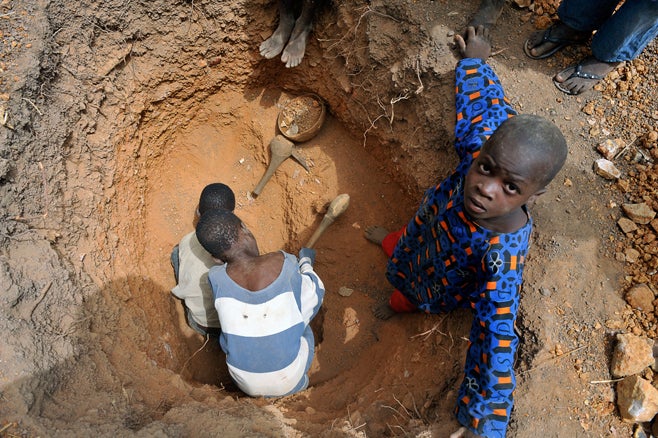
According to a Human Rights Watch (HRW) report released this past December, some 20,000 – 40,000 children work in artisanal gold mines in Mali, Africa’s third-largest producer of this precious and highly coveted metal. The 108-page report, “A Poisonous Mix: Child Labor, Mercury, and Artisanal Gold Mining in Mali,” brought to light the plight of children as young as six years-old who labor in the dangerous mines digging shafts, working underground, and pulling heavy weights of gold ore. Many of these children are placed in even deadlier conditions working with toxic mercury, used to separate the gold from the ore. HRW children’s rights researcher Juliane Kippenberg said children carried loads heavier than their own weight, climbed into unstable shafts, and touched and inhaled mercury. Mercury is especially harmful to young children; it is considered to be one of the most toxic substances on earth as it attacks the central nervous system. Symptoms of mercury poising include impairment of vision, hearing, speech, sensation and a lack of coordination.

Read the rest of this post by our Executive Director and Founder, Cassandra Clifford on the Foreign Policy Association's Children's Rights Blog here.