Welcome to the Bridge to Freedom Foundation Blog


Thank you for visiting the Bridge to Freedom Foundation (BTFF) blog, where we look forward to bringing you inside information on the inner-workings of BTFF, inside information on our volunteer team and leadership, in-depth coverage of BTFF and partner events, news and happenings from across the globe and so much more.

Learn more about Bridge to Freedom Foundation and how you can help on the BTFF website. We do hope you will subscribe to and follow our blog and please e-mail us at blog@btff.org if you have any feedback, ideas or contributions.

Thank you for your support!
Cassandra Clifford
Executive Director and Founder of BTFF
Showing posts with label Modern-day slavery. Show all posts

Thursday, January 2, 2014

Supply Chains: The Need for Monitoring and Accountability

Who assembles the various gadgets such as iPhones, iPads, tablets, and laptops most of us use on a regular basis? Who picks the cotton used to make our clothes? Who harvests the cocoa beans used to make our favorite chocolate items? Many consumers do not know the answers to these questions and the reason lies in the basic relationship between businesses and customers. Customers need things. Stores provide them. Customers buy them. The producers and sellers make a profit while the consumers come into possession of a desired object. It appears as if all sides are satisfied, and the balance is preserved with no questions asked. This is unfortunately not quite the case.

A product’s journey from the point of origin to an American store can be legitimate, but as Anti-Slavery International and the What We Buy campaign highlight, in an increasingly globalized economy it is difficult to determine when exploitation might play a role in product development and assembly. Indeed, the Products of Slavery visualization clearly indicates that 12.3 million children and adults across 58 countries work in forced labor, making 122 types of products. A January 2012 report by the CNN Freedom Project reveals that children as young as ten years old are already experienced veterans in the cocoa fields of Ivory Coast, Africa. These children have never even tasted chocolate. Kevin Bales of Free the Slaves, however, warns that refusing to buy certain products is not always the best solution to the problem as the materials from a product come from various sources and only a small percentage might include slave labour. Not buying a product then punishes both the producers who use forced or child labour and the ones who do not. A different strategy is needed.

A plethora of initiatives in recent years address the need to require big corporations to take necessary steps to reduce and eventually eliminate forced and child labour from their supply chains. An example is the work by U.S. lawmakers in California. On January 1, 2012, a new law named the California Transparency in Supply Chains Act (SB-657) was enacted. To rid the product supply chain of any slavery or child labor, businesses in California with global revenue in excess of $100 million must publicly disclose their efforts to verify, audit and certify their direct suppliers. Employees working with the supply chain must also receive training on human trafficking and slavery.

The law will only work, however, if companies are held accountable to it. With that in mind, on October 21 KnowTheChain was launched by Humanity United and 12 partner organizations. It is an online resource educating companies, investors, policymakers and consumers about the existence of slavery in supply chains. Readers are able to see the public disclosure status of hundreds of companies as well as find additional information about the issue.

Consumers certainly play a role in addressing the problem and have great power when choosing what to buy. KnowTheChain enables us to bypass companies refusing to clean up their supply chains and instead give our money to those that take the issue seriously. It is a simple step that will change the outcome for millions who are powerless to alter their own lives.

Tuesday, December 17, 2013

Lisa Kristine Donates Photo for National Global Human Trafficking Awareness Day Poster

We are delighted to announce that Lisa Kristine, world renowned humanitarian photographer, has donated the rights to use one of her human trafficking images on our 2014 National Global Human Trafficking Awareness Day Poster.
Awakening compassion and igniting action in a worldwide audience with powerful, broad-sweeping images of courage and tender, intimate portrayals, Lisa elevates significant social causes-such as the elimination of human slavery and the unification of humanity-to missions. Lisa has gained broad recognition for her collaboration with the NGO Free the Slaves. This breathtaking body of work, illuminating human enslavement, is brought together in Slavery, published in 2010. Lisa has received global attention for shining a light on contemporary slavery across media platforms, including CNN and Reuters, speaking at TED events, museums, NGO's, business conferences, colleges and universities.

 Last month, Lisa was honored with a Lucie Award for her work as a humanitarian photographer. Bridge to Freedom Foundation is privileged to be able to use one of her moving images of modern slavery, so please stay tuned as we will unveil the 2014 NGHTAD poster in the coming weeks. In the meantime, please visit -and share- Lisa's website to see some of her remarkable work.

Friday, October 18, 2013

Fact: UK Anti-Slavery Day, October 18th


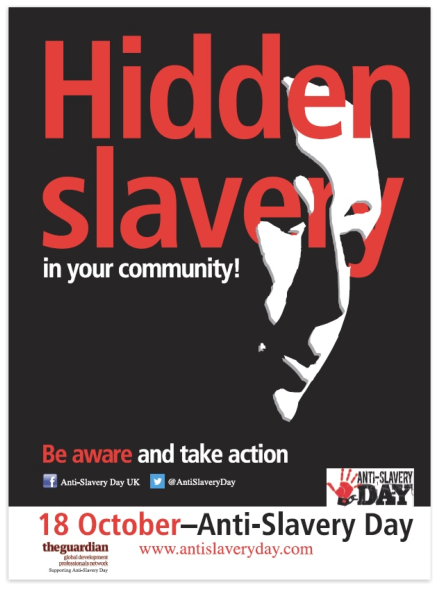
Today the United Kingdom celebrates, Anti-Slavery Day, which falls on 18 October each year. The day provides an opportunity to draw attention to the subject and to pressurize government, local authorities, public institutions and private and public companies to address the scale and scope of human trafficking.

The Anti-Slavery Day Bill became law in 2010. It was introduced in Parliament as a Private Members Bill by Anthony Steen MP for Totnes, South Devon, in 2010 and passed through both Houses, unopposed although amended. The bill defines modern-day slavery as child trafficking, forced labour, domestic servitude and trafficking for sexual exploitation.

Monday, September 16, 2013

Modern Slavery News Round-Up

Great Britain: 'Modern slavery' bill to tighten laws on human trafficking
Home secretary, Theresa May, aims to toughen legislation and counter 'shockingly low' prosecution rates. The home secretary said that prosecution rates for human trafficking were still "shockingly low" across Europe and that an overhaul of the law was needed as there was still some uncertainty over which agencies should be tackling the problem. The bill, which will be introduced before the current session of parliament ends next spring, will consolidate and toughen existing anti-trafficking legislation.

Texas: Bill would target domestic human trafficking
Sen. John Cornyn, R-Texas, said the Justice for Victims of Trafficking Act, co-sponsored with Rep. Ted Poe, R-Humble, will add to existing federal efforts to combat what he called the “scourge of human trafficking.” “We have to make human trafficking unprofitable, and we have to make the consequences such that people simply don't want to risk it,” he said. The bill would create a special fund that would finance human trafficking deterrence and victims' support programs through fines and penalties assessed on those convicted of child pornography, sexual exploitation, human trafficking and human smuggling offenses. Currently, about $20 million to $30 million in federal money goes to domestic trafficking prevention and deterrence — far less than that dedicated to international trafficking deterrence programs, Cornyn said. His bill would boost federal funding for domestic human trafficking victim support programs by an estimated $10 million to $20 million.

Black Mauritanians suffer 'slavery-like' conditions, says UN Black Mauritanians are still subject to slavery-like practices, including sexual violence and discrimination, a UN human rights expert has said. The UN special rapporteur on racism, Mutuma Ruteere, told the Guardian that generations of people, particularly women and girls, were still living with families in a "slavery-like" relationship, and were being forced into sex with male relatives, in some cases with their fathers.

Mauritania: Modern-Day Slave Finds Freedom in the Desert
At SOS Esclaves offices in Nouakchott, Mauritania's capital, Matallah Ould Mbarak Alsalem prepares tea. Matallah is a handyman and cleaner at SOS Esclaves, an NGO dedicated to the fight against slavery and coming to the aid of slaves and former slaves. He is one himself. Born in a desert region of north-eastern Mauritania, his mother was a Hratine, a slave, and by convention so was he. The Hratine, the main slave caste, are descendants of black African ethnic groups subjugated for the most part by white Arab Berbers. Estimates indicate that 10-20 percent of Mauretania's 3.5 million people are slaves, though exact numbers are hard to come by.

Cindy McCain: Address human trafficking before 2015 Super Bowl
McCain is calling on Arizona leaders to enact harsher penalties for human traffickers before the Super Bowl lands in Glendale in 2015 because the sports event is one of the largest drivers of the sex-trade industry. The annual football game is among the most-watched sports events in the world and draws tens of thousands of people to its host city. State attorneys general in Texas and Indiana, where recent Super Bowls were held, and other experts, have said the event creates an ideal setting for traffickers because they easily can go unnoticed in the influx of people, according to media reports. New Jersey, which will host the 2014 Super Bowl, recently passed a new law toughening penalties for traffickers.

ILO Initiative Protects Women from Modern-Day Slavery Over 100,000 girls and women in South Asia are set to benefit from a new initiative by the International Labor Organization and the UK Department for International Development, which aims to prevent trafficking within the region and to the Middle East. The Work in Freedom program, funded by UK aid, will focus on trafficking in domestic labor and the garment sector through known labor trafficking routes from Bangladesh, India and Nepal, to Jordan, the United Arab Emirates, Lebanon and India.

Thursday, September 12, 2013

Death of Child Bride in Yemen an All too Familiar Story


The recent story on the child bride in Yemen who was killed has me fired up again, as over the years I have written many times on child marriage across the globe.
"Al Nahar, Lebanon, has reported that an eight year old child bride died in Yemen on her wedding night after suffering internal injuries due to sexual trauma. Human rights organizations are calling for the arrest of her husband who was five times her age" (albabwa).
 Not only have I written countless times on the global plague of child marriage, but even more I have reported on Yemen numerous times since at least 2008, when I published  "Girls in Yemen Forced to Marry too Young".

In 2010 I even reported on a story that almost mirrors the one that is causing global outcries as we speak,  when a 12 year-old child bride died; "Child Marriage in Yemen Turns Deadly" and "Yemen Fights to Ban Child Marriage" just to name a few.

I am truly fired up over this one -not simply because of the shocking and unspeakable nature of the child's death, but as we have sought to speak out for so many years to only have the cries of child brieds in Yemen and across the globe continue to be silenced.  We cannot stand by one more day and ignore these innocent children, most of whom do not have their stories told and not only cry in silence, but who's deaths gain no tears.

 Stay tuned I have a lot more to come and will be writing a new post with a fresh perspective shortly.

Monday, September 9, 2013

Modern Slavery News Round-Up

Demands grow for child guardians to end shame of modern slavery in the UK 
Safe accommodation could stop suspected victims being found by traffickers, say experts.The number of children identified as potential victims rose by 12% last year, according to a recent report by the UK Human Trafficking Centre. It identified 2,255 potential child victims – up from 2,077 the previous year. Advocates of guardianship say it would ensure secure housing, education and legal support to stop trafficked children falling back into the hands of their exploiters.

Nail bars: modern-day slavery in plain sight?
...the beauty industry was one of the most resilient and dependably priced of all throughout the latest recession – nail-care businesses and lipstick sellers in particular. But it turns out that there may be another, far darker reason for the rise of the affordable manicure in the UK of late. A report by the Sunday Times (paywalled link) this week presented evidence about nail salons staffed by illegal immigrants, specifically from Vietnam. According to the report, industry insiders estimate that there are 100,000 Vietnamese manicurists working in the UK, despite only 29,000 Vietnamese-born migrants officially being registered in census data. [Questions raised below by commenters over these figures have been addressed in our Reality Check blog – see footnote.] It alleges that some of these illegal migrants are victims of "what appears to be a human-trafficking network" and that they are sometimes forced to work as prostitutes as well as manicurists. According to the latest numbers from Eurostat, 80% of human trafficking victims are female.

The economic case for ending slavery
Instead all of us in the anti-slavery organisations must start working together to effectively make the case to governments and the private sector of the economic benefits of eliminating slavery, over and above the unarguable moral case to end this atrocity. $32bn (£21bn) in annual profits sounds impressive doesn't it? Who wouldn't be happy with such huge profits? The problem is, that is the estimate of how much criminals make from modern slavery every year (pdf). It's a powerful statistic, and one of the most commonly cited. But it is becoming increasingly clear that focussing on these criminally generated profits frames the problem wrongly, and risks undermining effective policy action to end this atrocity.

Tuesday, September 3, 2013

Sharing the Labor Day Spirit


Photo Credit: UN News Center

 Like myself, most of you, were barley able to wind down a long weekend full of end of summer trips, pool parties and BBQ's in honor of Labor Day- and are now rushing to get the kids to school or the catch-up on work. Nonetheless I hope you you all had the best weather and the time to both rest and play!

Other than the end of summer, what is the meaning behind Labor Day? According to the Department of Labor (DOL), Labor Day “is a creation of the labor movement and is dedicated to the social and economic achievements of American workers” and “constitutes a yearly national tribute to the contributions workers have made to the strength, prosperity, and well-being of our country.” After more than 20 states adopted a holiday in honor of workers during the late 1800s, Congress passed an act on June 28, 1894 making the first Monday in September of each year the legal holiday of Labor Day.

 However while most of us in the U.S. took a well deserved weekend off and a day to celebrate our achievements and hard work, millions of others around the glob have never seen a day off, been rewarded for their hard work, nor giving a needed break or rest from the grueling routine of physical labor.  According to the International Labor Organization (ILO) some 21 million are victims of forced labor, an estimated 5.5 million of which are children under the age of 18. "According to new ILO estimates, three out of every 1,000 people worldwide are trapped in jobs into which they were coerced or deceived and which they cannot leave."  Forced labor included those who are trafficked for sexual exploration, forced to work in agriculture or mining and as domestic workers.

The fight against forced labor is a global fight, however it is a fight that can be won through unified global action, laws and the enforcement of such laws, empowerment/education, gender equality, and consumer awareness.

How do we take the first steps to move forward? First we must ensure that the voices of men, women and children around the world are heard, and that we keep the true spirit of Labor Day alive all year round -to remember not all are rewarded and honored for their hard work. Thus we never forget that forced labor labor continues to be prevalent, one must seek to educate themselves and others on the issue.  We must be aware that forced labor comes not only at the cost of the laborer and their families, but also ours and that we are part of the supply chain wither we want to be or not -for it is in our daily products.  Products such as coffee, tea, sugar, vegetables and fruit, cotton,, cell phones, and so much more.  Therefore, one must become a conscious consumer and try to shop Fair Trade as often as possible and support your local community.

Today education is the first step (You've read this post great start), tomorrow we begin to take action as we speak out and spread the word to others (share this post with your friends via e-mail, Facebook and Twitter), and continue to educate yourself and take a more active role as a consume (check out Free2Work for a list of tainted products and download their app to help while your shopping.  As long as we continue to educate ourselves on the issue and the products modern slavery taint to make educated purchases and take a stand against companies who support the demoralization and harm of others, we will see an end to slavery  in out live time and know that we all have a role to play.

Wednesday, August 28, 2013

2013 State Ratings on Human Trafficking Laws


The Polaris Project has rated all 50 states and the District of Columbia based on 10 categories of laws that are critical to a basic legal framework that combats human trafficking, punishes traffickers and supports survivors. 39 states passed new laws fighting human trafficking in the past year and as of July 31st they were rated (Tier 1). The states of New Jersey and Washington have perfect scores, meaning that they have governmental laws the fulfill all 10 categories and large improvements have been made to Arkansas, Wyoming, Mississippi, and New Jersey. Ratings are showing that 32 States have passed significant laws to combat Human Trafficking and should continue to take additional steps to improve and implement its laws(Tier 1), 11 States and DC have passed numerous laws to combat human trafficking (Tier 2), 6 States have made nominal efforts to improves laws to combat human trafficking and should take major steps{Tier 3) , and 1 state has not made legal effort to enact a basic legal framework to combat Human Trafficking and should actively work to improve Laws.
Read More. 

Monday, August 19, 2013

Modern Slavery News Round-Up

Human Trafficking Fighters Improve Rating for Wyoming
 The leading organization in the global fight against human trafficking and modern-day slavery lauded the state of Wyoming on Wednesday for finally adopting a law to combat the practices. The Polaris Project lifted its Wyoming rating from zero to tier two, with four being the highest, as a result of the legislation signed into law by Gov. Matt Mead last winter. Wyoming became the final state to adopt a statute outlawing human trafficking. Federal authorities previously had prosecuted such cases in Wyoming.

Trial Date Set in Sex Trafficking Case. 
A federal judge in Wichita has scheduled an October trial for three people charged in a sex trafficking scheme linked to Asian massage parlors. U.S. District Judge Eric Melgren on Wednesday issued an order scheduling an Oct. 15 trial for Gary H. Kidgell; his wife, Yan Zhang; and employee Xiuqing Tian. They are accused of conspiring to recruit women from around the country to come to Wichita to work at massage parlor, then coercing them into prostitution.

From Foster Care into Sex Trade. 
Every year, federal and state governments pour millions of dollars into combating sex trafficking through local and federal law enforcement agencies. But the emerging link between the child welfare system and child sex trafficking in the United States underscores the need for a new tactic, one that addresses the social origins of child sex trafficking.At the end of July, the FBI’s Innocence Lost initiative, the wing of the agency tasked with addressing domestic child sex trafficking, conducted its annual three-day Operation Cross Country. During these 72 hours, federal agents across the country “recover” juvenile victims from sexual exploitation and arrest their exploiters. This year, the agency boasts that it saved 105 children and arrested 152 pimps. According to U.S. law, anyone under 18 and involved in the sex trade is considered sexually trafficked.
 
Kansas Anti- Human Trafficking Efforts Gain Attention.
Kansas is earning national recognition for its efforts to combat human trafficking. An annual report from the "Polaris Project" puts Kansas in the top group of states in fighting human trafficking crimes. The report ranks Kansas in a tie for 11th-best overall. Last year, the state ranked in the bottom third. Kansas Attorney General Derek Schmidt credits a new state law for the jump. Enacted earlier this year, it increases services for human trafficking victims and strengthens support for enforcement of anti-human trafficking laws.

Monday, August 12, 2013

Modern Slavery News Round-Up

Loyola Professor studies Modern-Day Slavery in New Orleans.
New Orleanians have always had a relaxed attitude about many things other cities deem illegal. But what happens when such cultural acceptance is extended to really serious issues like prostitution like Storyville back in the day or what is now called human trafficking. On this week's Notes from New Orleans Sharon Litwin talks with Laura Murphy, Assistant Professor and Director of the Modern Slavery Research read Project at Loyola University about where New Orleans stands on the issue of human trafficking.

Thailand arrest suspect leader in Human Trafficking Case.
Ko Myo, a 42-year-old Myanmar national, was shot and captured at a rubber plantation in southern Surat Thani during a raid by the Department of Special Investigation (DSI) and local police. The raid follows mounting international concern over the trafficking of Myanmar migrants in Thailand's lucrative fishing industry, one of several sources of human slavery in the country that could trigger U.S. sanctions. It also follows a Reuters investigation published on July 17 that found human smugglers selling some Rohingya Muslims into slavery on Thai fishing boats. Thousands of Rohingya have fled Myanmar in recent months after violence with Buddhists, who follow the country's majority religion.

Child Labor around the Globe.
Under the Convention on the Rights of the Child ratified by 154 countries, child labor is prohibited. But despite this, child labor is not only massively used in the factories, but is also becoming more common. According to the International Labor Organization, in developing countries about 250 million children have to work. It is reported that there are 153 million working children in Asia, 80 million - in Africa, and 17 million - in Latin America. "Many of them work under the conditions that are dangerous to their physical, mental and emotional development," human rights activists report. For example, children are involved in activities such as slavery, prostitution and pornography, participation in armed conflicts, as well as working in mines, agriculture and construction.

Monday, July 22, 2013

Modern Slavery News Round-Up

Andrea was 14 years old the first time a voice over the Internet told her to take off her clothes.
"I was so embarrassed because I don't want others to see my private parts," she said. "The customer told me to remove my blouse and to show him my breasts."  Andrea, which is not her real name, said she had been lured away from her rural, mountain village in the Philippines by a cousin who said he would give her a well-paid job as a babysitter in the city. She thought she was leaving her impoverished life for an opportunity to earn money to finish high school. Instead, she became another victim caught up in the newest but no less sinister world of sexual exploitation; cyber-sex trafficking. Read More

Fighting Forced Labor Helps Women Beat Poverty.
Across the planet, about one in every seven of us lives in extreme poverty, having to survive on less than $1.25 a day. Every day, they and the millions more living just above the poverty line struggle to have enough to eat, and dream of a better life and of earning enough to provide for their families.  Geeta Devi was one of these people. The 32 year-old mother of two from Nepal had been struggling to support her children and, like millions before her, made the difficult decision to leave her family behind in search of better work. Geeta, whose real name is being withheld to protect her safety, left her home believing she had secured a job through a local recruitment agency to work in a hospital in Lebanon. Read More

 Forced Labor Accounts for Thousands Missing in Mexico’s Drug War 
A recent report indicates that civilians caught in the crossfire between drug cartels and the Mexican government may be also serving as human chattel, forced to perform labor in gang-run camps. The Spanish-language magazine Proceso features interviews with victims’ relatives and members of civil society, all of whom tell of a vast system of forced labor throughout Mexico. These laborers are counted among the 26,000 “disappeared” in Mexico. Civil society groups tell of some of these captives being alive but forced to perform “jobs” on behalf of the cartels. These can include “forced killings, preparing marijuana, constructing tunnels, cleaning safe houses, preparing food, installing communications equipment, and acting as lookouts or sex slaves.” The idea of cartels kidnapping individuals to perform specialized tasks is also well-documented, lending credibility to Procesco’s report. InSight Crime notes, however, that some of the claims Proceso make could still be inflated. Read more here.


Monday, July 1, 2013

Modern Slavery News Round-Up

20 Million People Are Trafficked in Modern Day Slavery – America is Leading the Fight to Stop It
One in three. That’s the number of women who will be sexually assaulted in their lifetimes, according to the United Nations. Depending on where they live, nearly three in five women will at some point endure physical violence. Of course, statistics don’t do justice to how brutally commonplace the occurrence of violence against women and girls is, whether in public or private spaces. The sad reality is these stories are reported in the news every day, all over the world in great detail from horrors in Delhi, India to Steubenville, Ohio. Unfortunately, these same news stories include messages of victim blaming, arguments of consent, and junk science meant to invalidate the seriousness of these crimes.

Arrest Made in Modern Slavery Case Involving a Mentally Disabled Women.
 A mentally disabled woman and her daughter were held in an Ohio apartment crowded with people and animals for more than a year, forced to perform manual labor and threatened with dogs and snakes to keep them compliant, authorities said Tuesday.Federal prosecutors said the people accused of holding the pair in Ashland, about 60 miles south of Cleveland, collected the woman's government benefits and beat her in order to get painkillers for themselves. They kept her in a room with a free-ranging iguana and ordered her to feed the reptile fruits and vegetables her daughter was denied, according to court papers. Sometimes their captors' pit bulls got table food while they had to eat from cans, according to an arrest affidavit quoting witnesses. Local news shows captivating images of the traffickers, To view  Click Here

Child Minors Face Death for Tech 
Roger-Claude Liwanga is a human rights lawyer from the Congo and visiting scholar at Boston University. He worked for The Carter Center as a legal consultant, where he developed a training module to train Congolese judges and prosecutors on the protection of children against trafficking for economic exploitation in the mines. He is also the co-founder and executive director of Promote Congo, and is currently directing and producing a short documentary, “Children of the Mines,” which will be launched shortly in Boston. He writes in his personal capacity.

Compiled By: Markesha Fantroy


Wednesday, June 12, 2013

Fair Trade Shopping for Father's Day

Its the American way to look for a deal and a bargain, but does your bargain gift come with a price? Global March Against Child Labor estimates that one in every eight children from 5 to 17 years old, some 179 million, work in the worst forms of child labor. Slavery taints many of our consumer products such as clothing, jewelry, cosmetics, electronics, sports equipment, rugs, agricultural produce, sugar, tea, coffee, chocolate, and many others. Often products, like clothing, may even be tainted at multiple points in the supply chain. For example children may have been used to pick the cotton of a shirt, while workers were held in situations of slavery and forced to sew the clothing.

Why not make your this Father's Day one that not only brings the joy of giving to the man who raised you, but is free from slavery and gives back to individuals and communities in need. Wouldn't Dad be so proud!

Slavery touches each one of us as a consumer, therefore take a stand against child and slave labor and work toward being a more conscious consumer and keeping slavery tainted products out of your home, today in just a few easy steps.

  1. Donate to local organizations that help empower people out of poverty & slavery, many can be found here; Fair Trade and Slave Free Links, Modern Slavery and Human Trafficking Links, and Child Soldiers Links

  2. Educate yourself about the companies that use slavery in the making of their products. Green America has a sweatshop free guide. Sweatfree Communities: Sweatfree Communities has a great shopping guide with a number of places to buy sweatshop-free apparel for men, women, and children. Fair Trade Federation: You can search their online directory for Fair Trade vendors in your area.

  3. Become a more conscious consumer and buy products made by survivors of trafficking or Fair Trade products. Amanda Kloer summed it up easily with her list of 7 Ways to Fight Slavery at the Grocery Store and this years post on where to find gifts that help human trafficking survivors. You can also see the Fair Trade and Slave Free Links list, which has a number of resources and sites where you can learn more about, and purchase Fair Trade or slave free goods.

Shopping consciously is also a bit about thinking outside the box so to speak. there are a number of other ways you can seek to shop, slave free, fair trade, green, etc.

Make your own gifts or support local artisans, you can also search online for handmade items; Artfire.com has artists from around the globe selling their crafts and art supplies, Etsy features handmade and vintage items, Ebay has a number of used, one of a kind and vintage items and even has a specifically designed sight World of Good, as does sites like Geebo.

Remember to recycle and reuse as much as possible, for not only does it help us reduce waste and maintain fight global warming, you can also help reduce the consumption of slavery tainted goods. Shop your local vintage and charity shops.

Friday, March 22, 2013

Fact: Debt Bondage is the Most Common Way to Enslave a Person

Pakistani farmers in debt bondage. Photo: BBC


Debt bondage, also know as bonded labor, is the most common method of enslavement and yet it is also less known, than other forms of slavery.

 What is Debt bondage? Debt bondage is when an individual's services as a laborer -a bonded laborer- are required or forced as a form of repayment for a loan. The individual is then coursed, fraudulently tricked or trapped into working off their debt. Individuals -and often entire families- are forced to work for very little, or no pay, in order to repay their debt -often for seven days a week.

Bonded laborers are forced to work to repay debts their employer state they owe, and not allowed to work for anyone else -including themselves. To hold a bonded laborer captive various forms of force are used; including physical threats and violence, surveillance, sometimes they are physically held under lock and key. The laborer is then charged many new and inflated fees for food, shelter, transportation, documents, etc. While the value of their work alone is worth more than the original sum of money borrowed or associated, the slave holder ensures that the debt continues to grow -most often to a never ending amount that then forcibly binds the laborer to their now slave master, the land, job or act for life -often a family may still be tied to a debt of another who has passes on years or even decades ago.

The UN Working Group on Contemporary Forms of Slavery recognizes that some 20 million people are still held in debt bondage around the world. However many estimate that the number of bonded laborers are substantially higher.

Friday, March 15, 2013

Fact: Males are Victims of Sex Trafficking


When you think about sex trafficking do you think about males?

You hear quite a bit about sex trafficking these days, but when you think about it the image of the victim that comes to your mind is that of a female. Sexual violence against males overall has always been a very culturally taboo subject. Regardless of the situations of abuse most male victims do not report their abuse and there are fewer services available to them...and no wonder there is very little mention of them. This lack of mention of male victims in society, by the media has led to what appears as a lack of concern and thus has rendered male victims almost invisible.

The statistics on male victims of sex trafficking are few and far in-between, but that does not mean that they are not out there. If we close our eyes, turn our heads or simply do not see it, it does not mean its not there. This is not a set of isolated cases, nor is it a foreign problem, it is a global problem that stretches from the world of the Bacha Bereesh -“beardless boys”- in Afghanistan to the streets of your very own cities.

Friday, March 1, 2013

Fact: You Have Slaves Working for You


Did you know that you have slaves working for you? We know you are shaking your head in horror right now saying, "no, way...it's not true I wouldn't ever do such a thing!" But the sad truth is you are -we all are! How is this possible you ask? Well have you been shopping lately? Did you buy a smartphone, computer, T-shirt, cup of coffee, a bar of chocolate? Well then the chances are, slaves made them. Modern Slavery and forced labor are sadly alive and well and it's tainting the supply chain and the consumer products we buy every day. The people who picked the cotton that made your T-shirt; the gold and diamonds in your jewelry; and harvest the coffee or cocoa beans in your mocha latte; may have all been slaves -and all were working for you. Some 27 million people are enslaved worldwide and they are supporting the lifestyle and cheap consumer products we have all grown used too. Slavery Footprint, a website and mobile app has been created to help us all measure the role forced labor plays in supporting our lifestyles. Therefore while we would all like to think that there are no slaves working for us, there are, but the great news is once we become more educated on what our "slavery footprint' is then we can begin to reduce it. While having no slaves at all impacting our 'slavery footprint" is the goal it is a long battle as even the most conscientious of consumers -like BTFF- are not exempt—according to the calculator -we all have slaves forced to work against their will for us, but by taking this first step we can begin to set them free.

Friday, February 15, 2013

Fact: Recruiters Modern Slavery Can be a Stranger or Someone the Victim Knows


According to a United Nations report, the recruiter in 54 percent of human trafficking cases was a stranger to the victim. In 46 percent of the cases, the recruiter was known to the victim. The U.N. report said that the “majority of suspects involved in the trafficking process are nationals of the country where the trafficking process is occurring.” The majority of suspects involved in the trafficking process are nationals of the country where the trafficking process is occurring.

Tuesday, February 12, 2013

US Senate Passes Trafficking Victims Protection Reauthorization Act (TVPRA) - Adds as Amendment to Violence Against Women Act (VAWA)


The U.S. Senate voted on Tuesday, February 12th, 95-3 to reauthorize the Trafficking Victims Protection Act (TVPA), one of the most important tools for the United States against human trafficking and modern-day slavery. The TVPA expired in September of 2011, placing critical anti-trafficking efforts at risk that includes support to law enforcement and services for survivors. To further support this important act, Senator Patrick Leahy (D-VT) recommended the TVPA reauthorization as an amendment to the reauthorization of the Violence Against Women Act (VAWA). The Senators voted 78-22 in favor of reauthorization for the VAWA, bolstering the impact of the TVPA as an important legislation against human trafficking and modern-day slavery.


Source: ECPT-USA

Friday, February 8, 2013

Myths and Realities of Human Trafficking


The reality of Human Trafficking is that it occurs in nearly every country and its networks are vast and difficult to investigate. According to the United Nations, there are between 27 and 30 million slaves in the world. The U.S. State Department cites that 600,000 to 800,000 people are trafficked across borders every year, but these numbers are often under-reported and victims are usually hidden, meaning that real statistics are hard to substantiate. This also means that there is a vast amount of incorrect information out there, which fuels the myths about human trafficking.

The most common myths are listed below and are further discussed by a contributor to Forbes' The Daily Muse:
  1. Myth - Human Trafficking and Human Smuggling Are the Same
  2. Myth - Most Traffickers Are What the Movies Show You
  3. Myth - Human Trafficking Only Refers to Forced Prostitution
  4. Myth - Only Women Are Trafficked
  5. Myth - Everyone Trafficked is Kidnapped or Deceived
  6. Myth - Trafficking Only Happens in Other Countries, Not in the United States
While the quest to better understand human trafficking seems a formidable task, the more you learn the more you are armed with the facts to better educate yourself and others, while being better equipped to take action against this global problem that reaches to our very own neighborhoods.

Sources: Forbes, The Daily Muse, "Human Trafficking: The Myths and The Realities"

Wednesday, February 6, 2013

What is Fair Trade?


We are very often asked, "what is Fair Trade?" Therefore we thought we would give you a brief definition and overview to get you started on how to be a more conscious consumer.

 The Fair Trade label is applied to products that pass a standard certification system. In addition to agricultural consumables, Fair Trade versions of sports balls, clothing, rugs, and other products can be easily found. Fair trade certification empowers workers and communities to lift themselves out of poverty by investing in their farms/businesses and communities, protecting the environment, and developing the business skills necessary to compete in the global marketplace. Fair Trade is much more than a fair price, it enables safe working conditions, living wages for workers, prohibits forced child labor and slavery, promotes environmental sustainability, and encourages community development. However, please note that just because a product does not carry the label, it does not mean that it is not Fair Trade, as many smaller co-ops and others have not yet been able to afford the certification. Nonetheless, do not let this put you off, being a conscious consumer and knowing where your products come from is always a better way forward for everyone, so don’t be afraid to investigate and do some research.

There are sites like Fair Trade Proof.org and the list on Fair Trade USA will help you find brands that sell Fair Trade Certified productsto help you get started.  I have also compiled a list of some Fair Trade and Slave Free LinksShopping Fair Trade and Slave Free this Holiday Season on the Foreign Policy Association Blog.

Please remember this is only a brief idea and with anything the best way to know is to research and ask questions.  Best tip we can give you is to start small and choose one item/product you consume or use to go fair trade with, such as coffee, tea, chocolate or sugar. Once you fine your fair trade staple in that category move on to the next one.